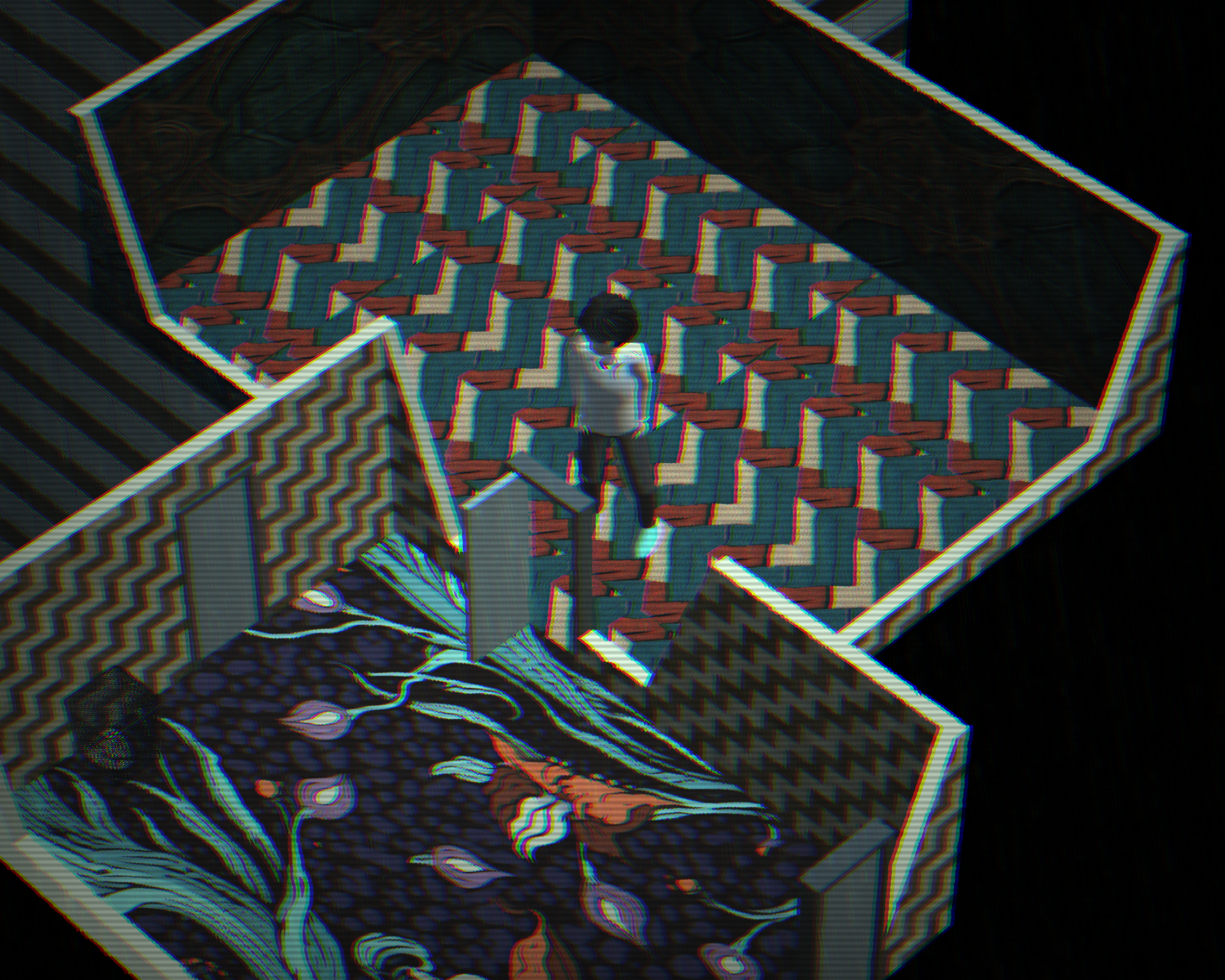
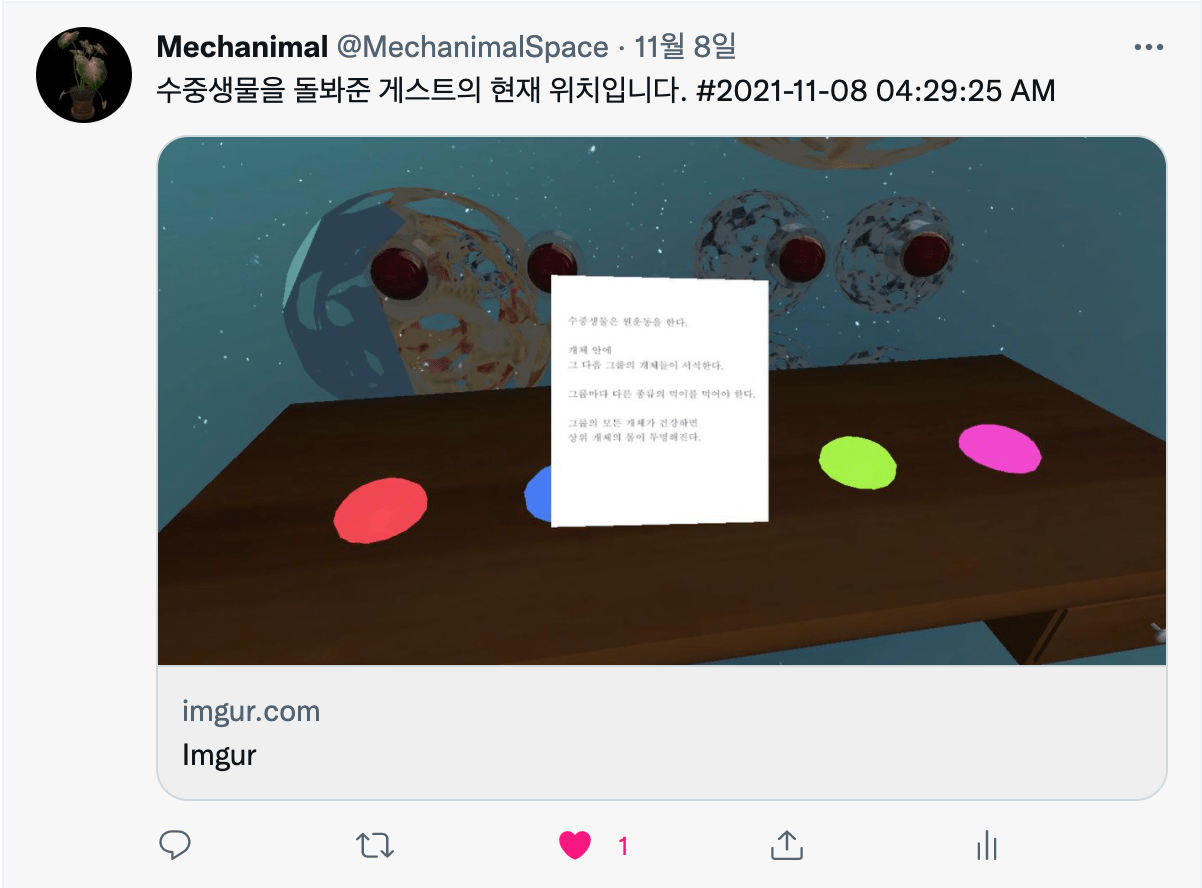
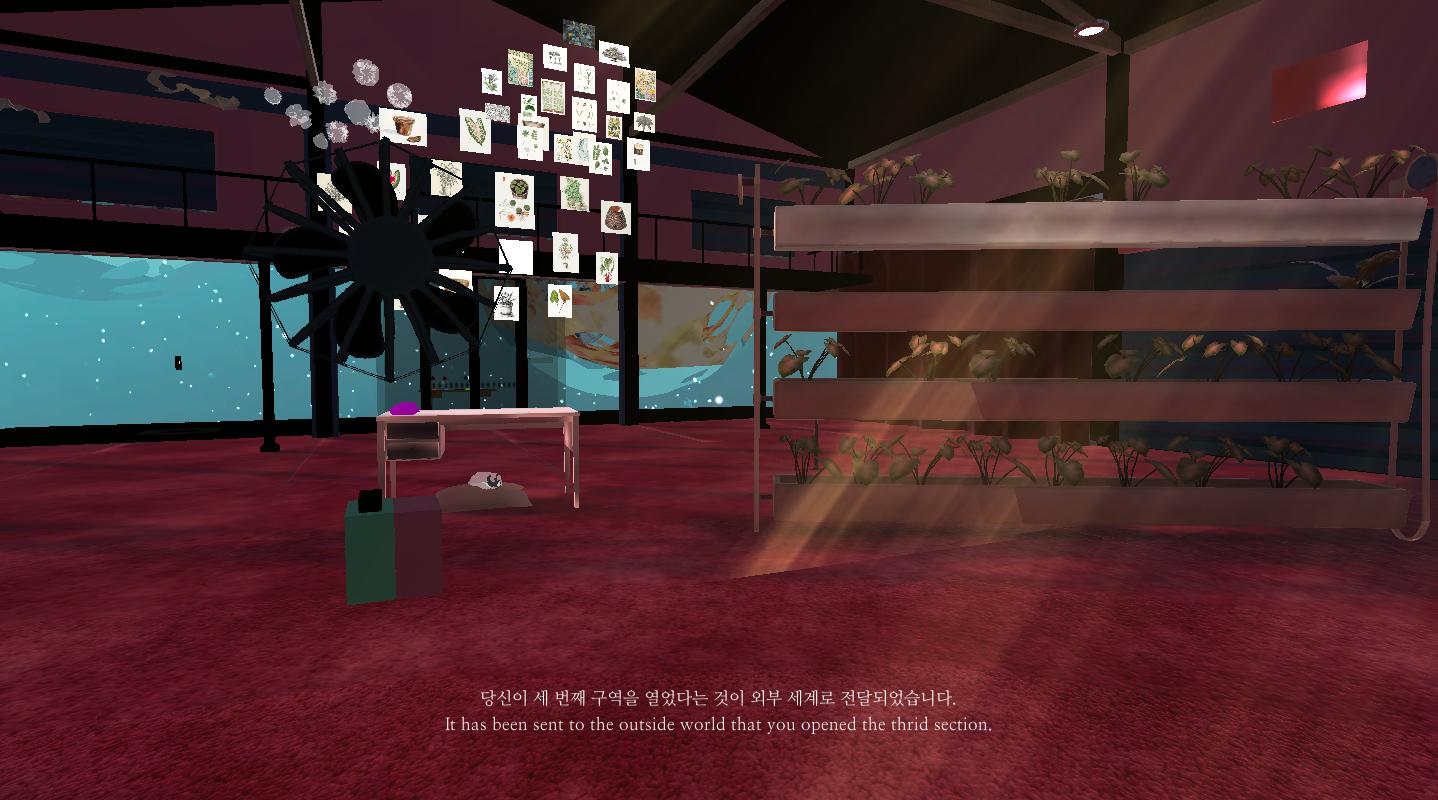
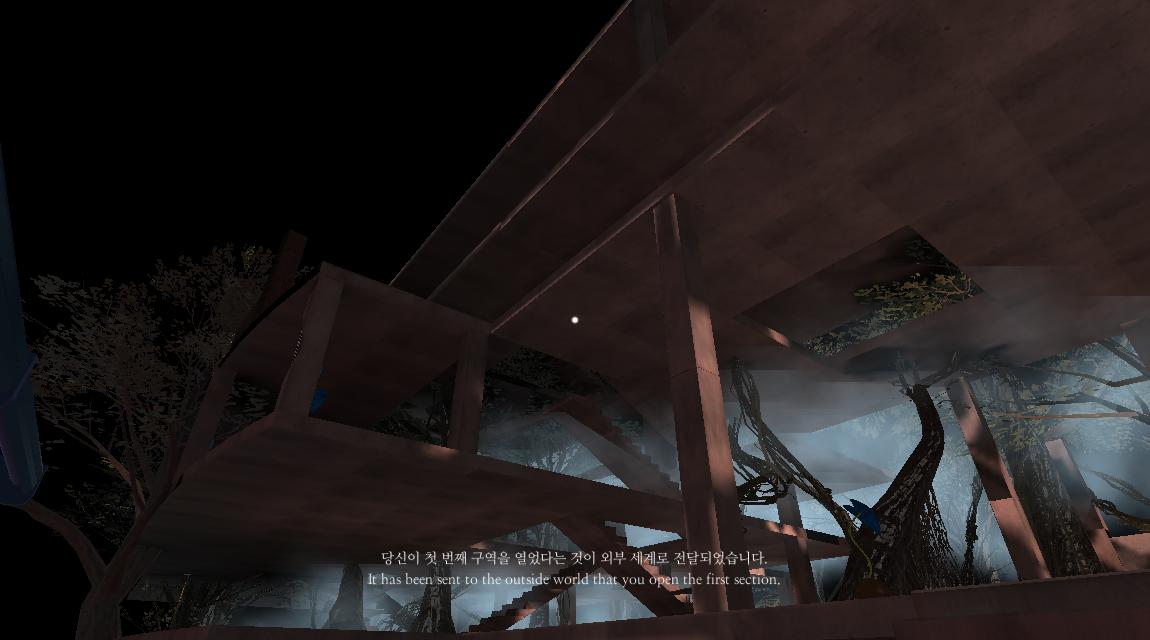
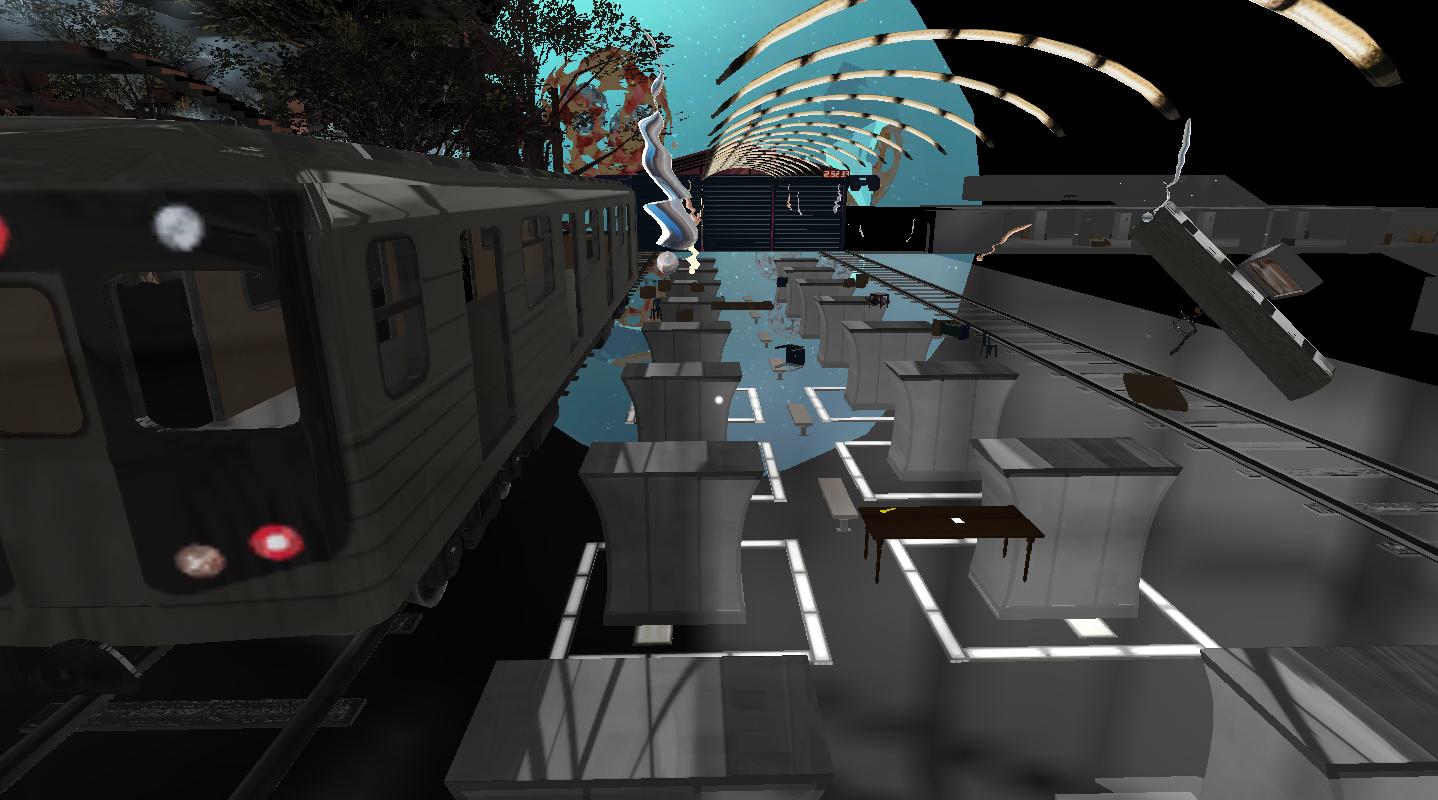
‹플레잉 아트 메소드›는 미술관에서 예술과 예술가가 구성되는 방식에 대한 사적인 대화에서 출발한 프로젝트다. 미술관에 게임 형식의 작품을 설치하는 과정에서부터 관객이 그것을 경험하는 순간까지 마주하는 다양한 단상을 바탕으로 담론의 장을 만들고자 한다. 룹앤테일은 이 전시 안에서 가상의 미술관과 그 안에서 플레이 할 수 있는 게임들을 만들고, 게임을 해석하는 다양한 방식을 탐색하는 플레이 비디오 시리즈를 전시 가이드와 함께 공개한다. 또한 전시를 확장하는 워크숍을 기획하고 추진한다.
Playing Art Method aims to create a platform for discourse based on the various ideas encountered when video games are brought into a museum setting. Loopntale creates a virtual museum within the exhibition and video games that can be played in it, and releases a series of play videos and exhibition guides exploring various ways of interpreting games. They also plan and hold workshops as extensions of the exhibition.
섹션 2. 변주들 – 플레이 비디오 시리즈 여기에는 두 세트의 ‘플레이 비디오’ 작업이 놓인다. 첫 번째 플레이 비디오는 섹션 3, 가상의 미술관에 등장하는 네 개의 게임을 재료로 한 4채널 비디오로, 게임의 대화법에 대해 이야기한다. 이 영상들은 게임의 작동 방식과 해석, 플레이 되지 않은 게임과 관객 사이의 관계에 주목한다. 두 번째 플레이 비디오는 3채널 비디오로, 상용화된 게임 에셋과 인디 게임 푸티지 등을 활용한다. 누군가 플레이했던 게임의 장면들로부터 다른 감각을 구현하면서, 또 다른 가상의 비디오게임을 만드는 플레이 모음집이다.
Section 2. Variations – Play Video Series Here are two sets of ‘Play Video’ works. The first Play Video is a four-channel video based on four games from the virtual art museum in Section 3, which talks about the conversational method of games. This video focuses on the operation and interpretation of games, and the relationship between the unplayed game and the audience. The second Play Video is a three-channel video utilizing commercialized *game assets and indie game footage. It is a collection of plays that creates yet another virtual video game using scenes taken from games played by various players to evoke different sensations.
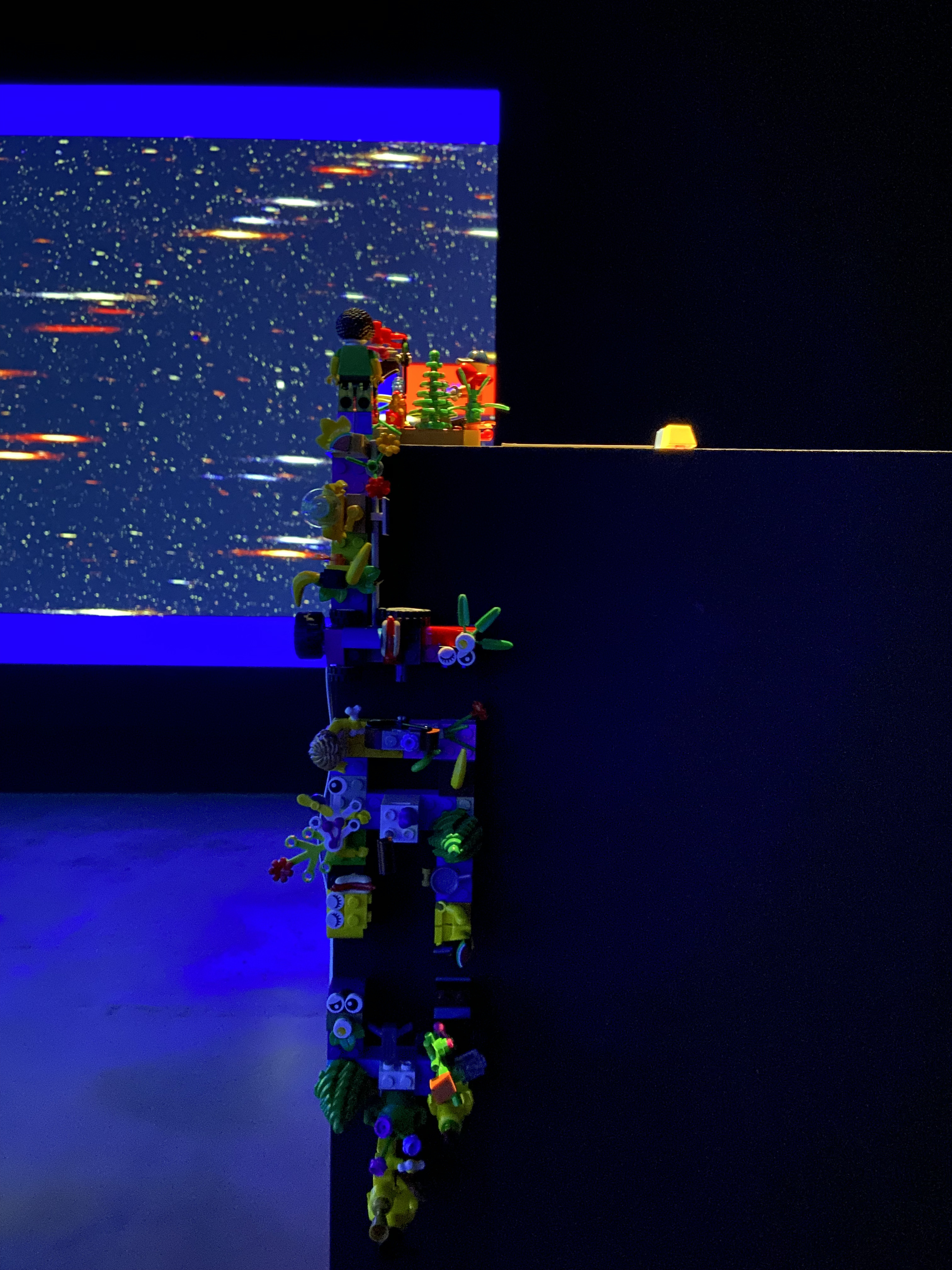
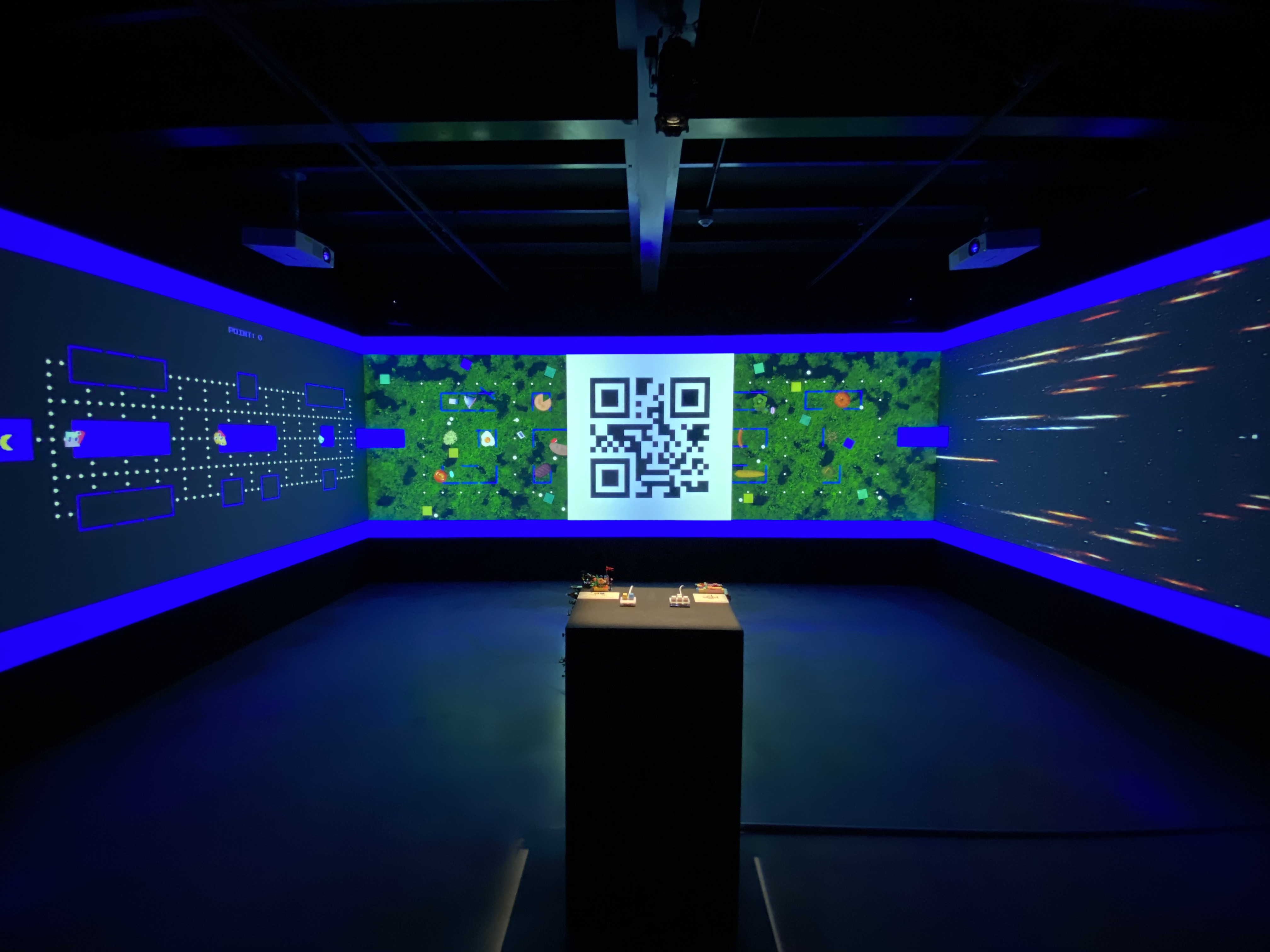
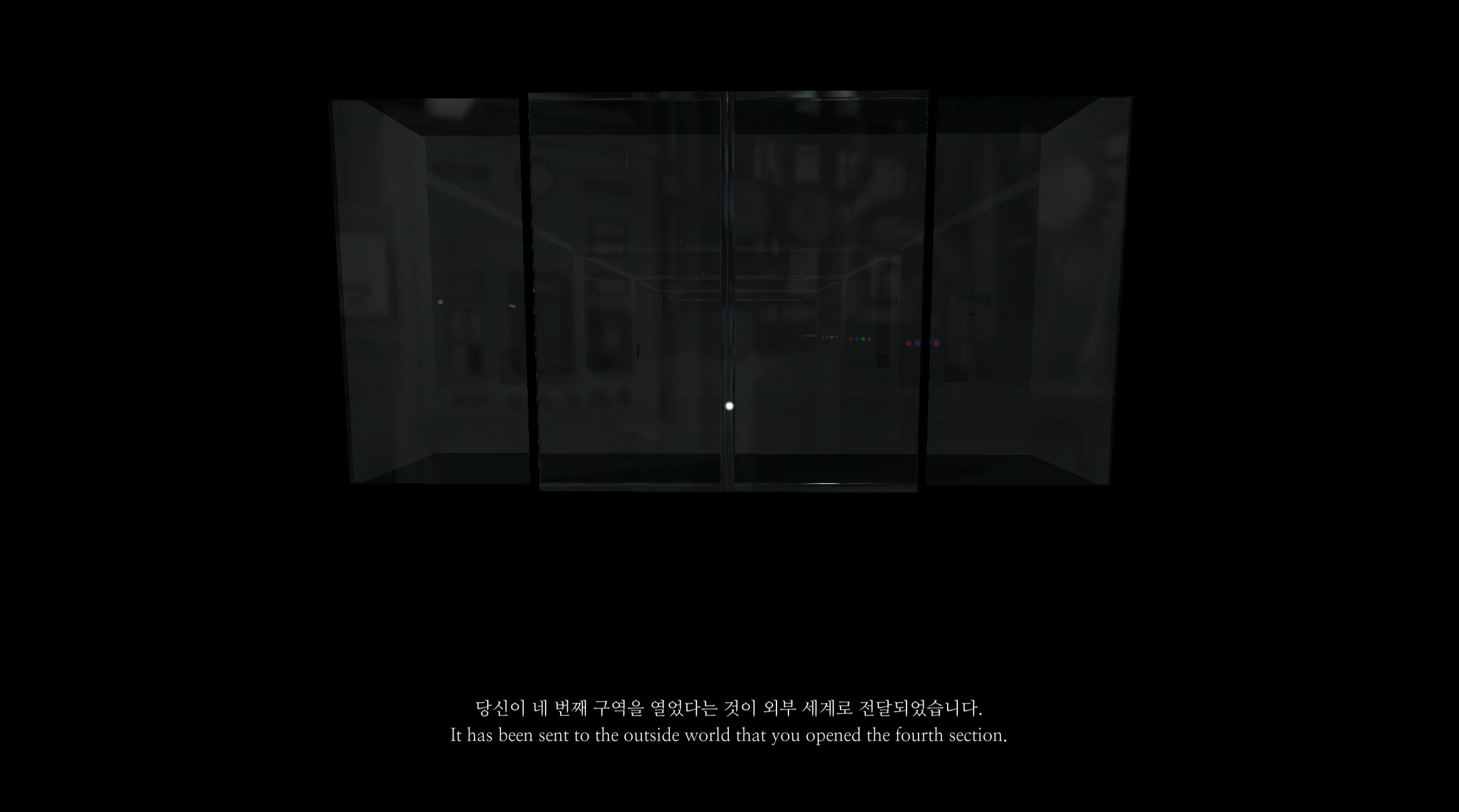
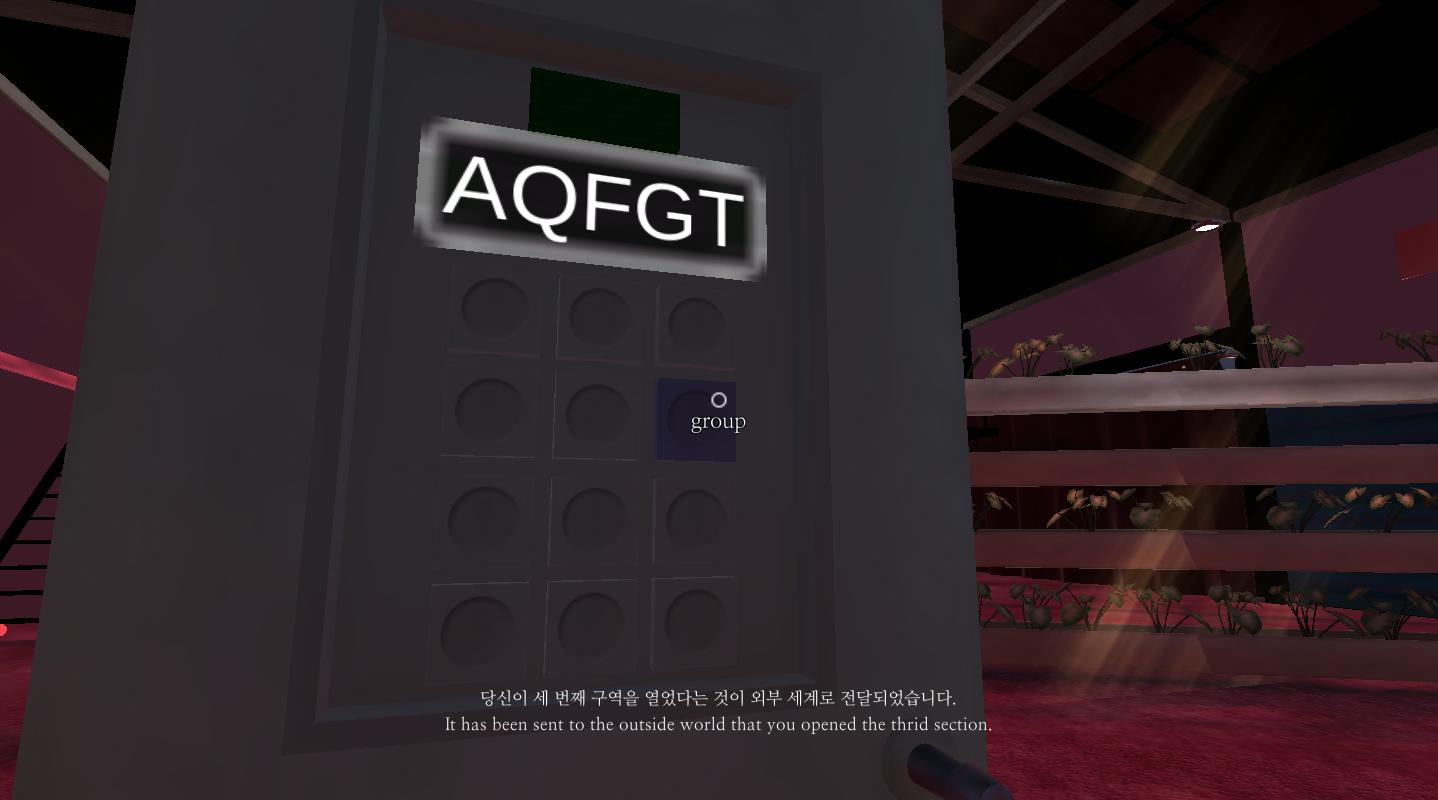
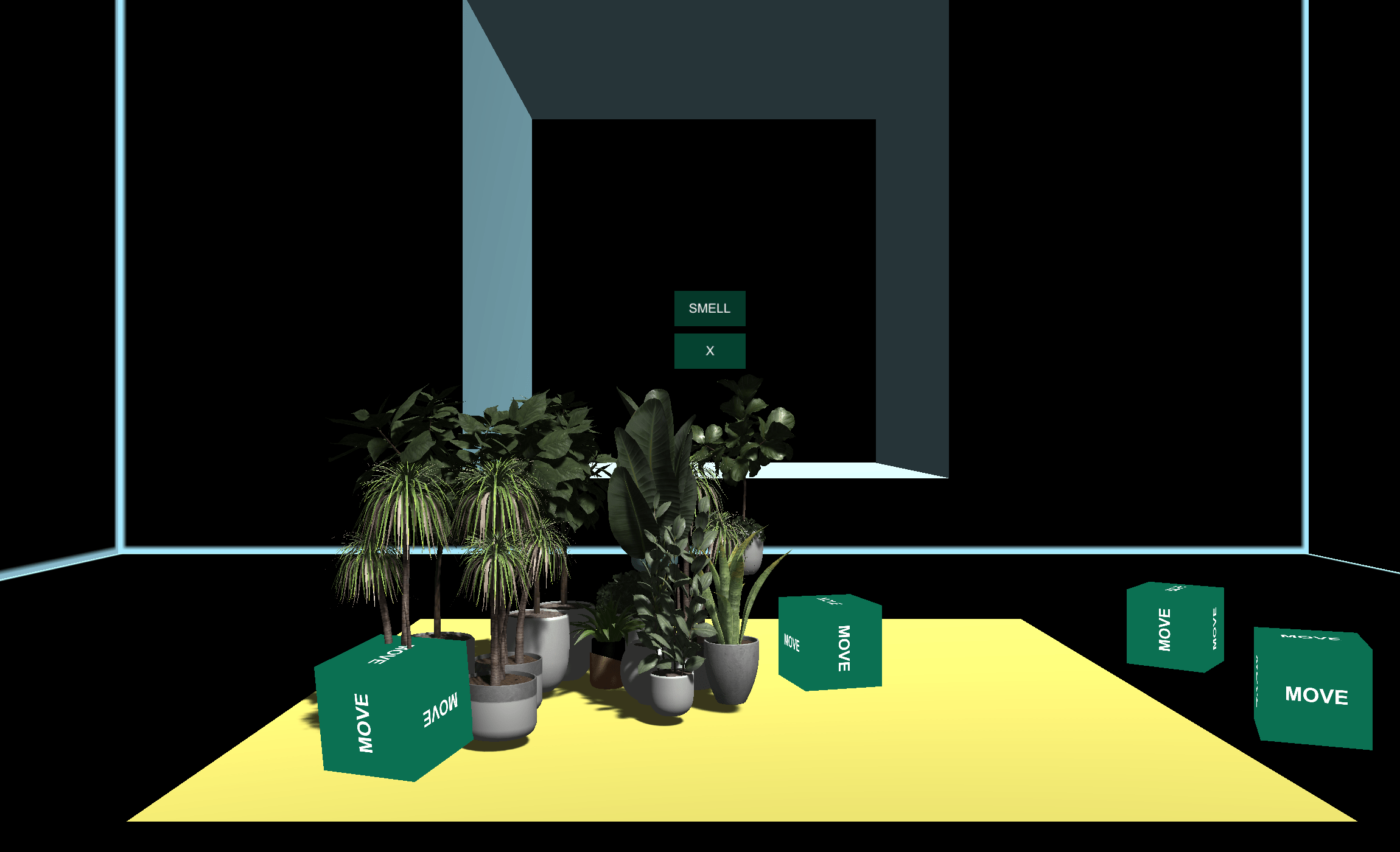
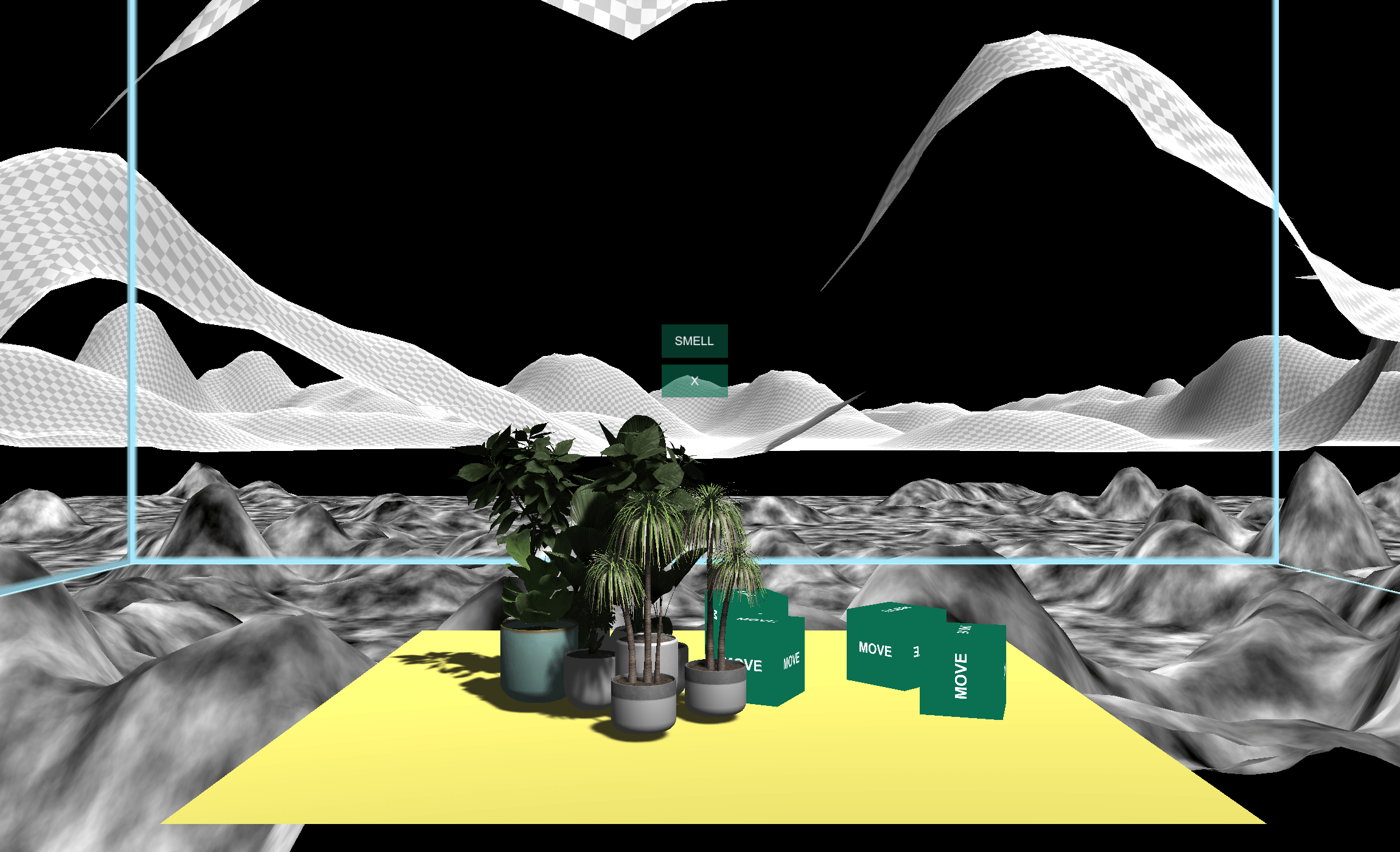
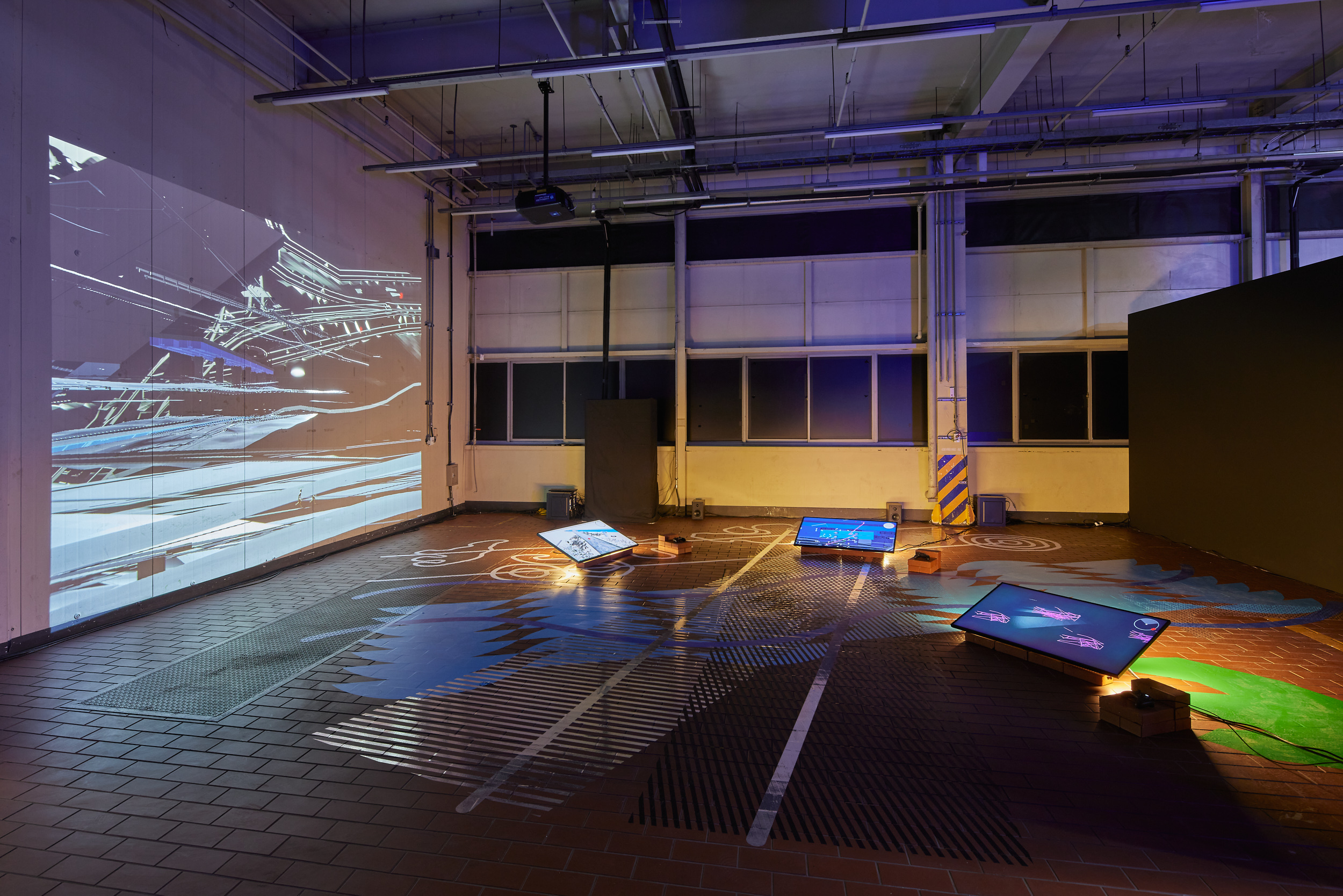
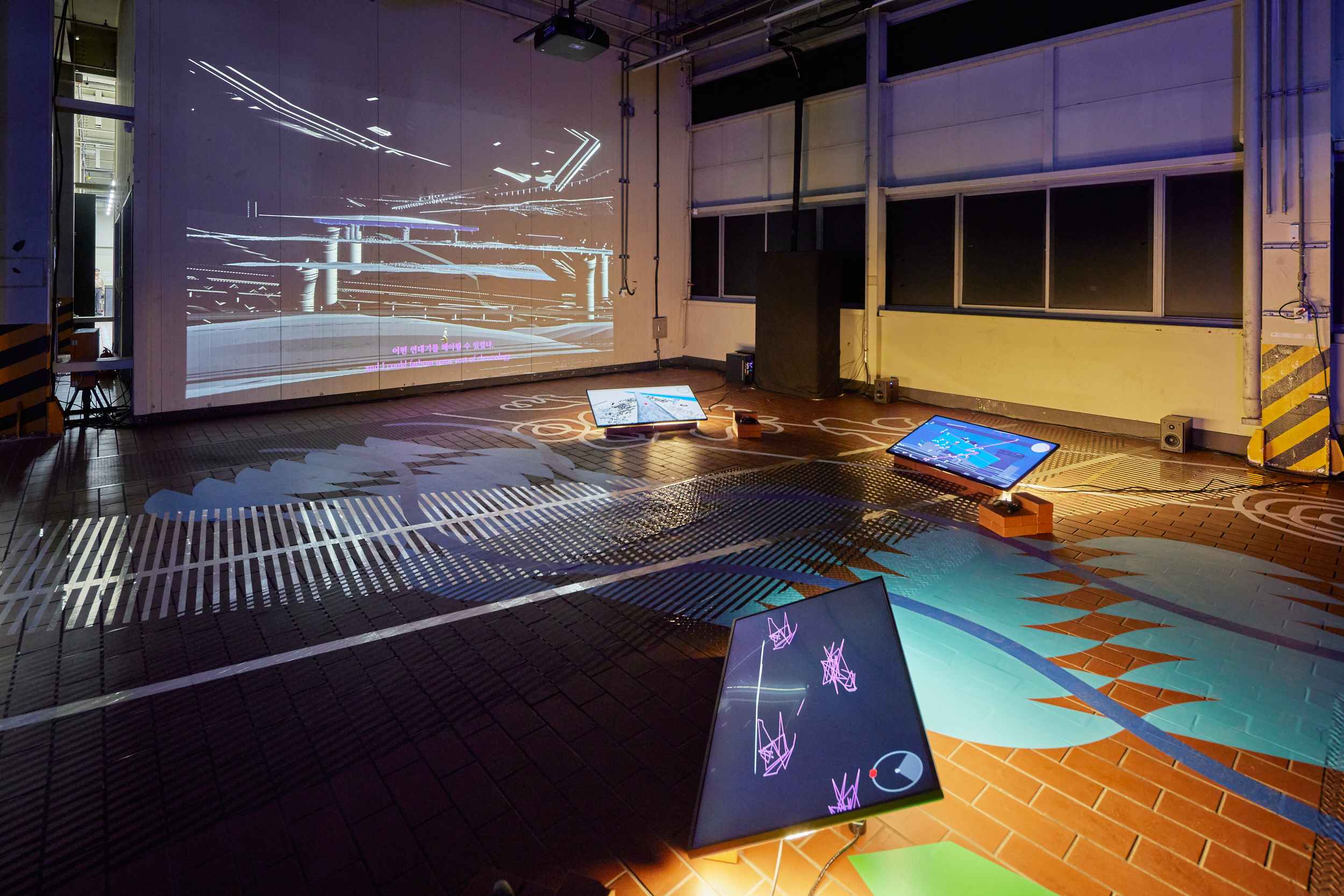
섹션 3. 존재하지 않는 전시 물에 잠겼다가 다시 드러난 가상의 미술관을 배경으로 자취만 남아있는 게임들, 자리를 잃은 표지판들, 누군가의 흔적들, 그리고 살아남은 네 개의 게임들이 있다. 두 개의 스크린에는 미술관 안과 바깥의 풍경이 있고, 하나의 컨트롤러로 동시에 플레이 할 수 있다. 게임을 하고 떠난 누군가 그리고 지금 미술관에서 게임을 하고 있는 사람들에 대한 관심이 투영된다.
Section 3. The Non-existent Exhibition Set against the backdrop of a virtual art museum that was submerged in water and has now resurfaced, there are games of which only traces remain, signs that have lost their place, traces of someone, and four games that have survived. The two screens show scenes from inside and outside the museum, and can be played simultaneously with a single game controller. Attention is drawn to those who have left after playing the game, and on those who are now playing the game here in the museum.
섹션 4. 목록들 – 전시 가이드 여기에는 게임의 세계관에 대한 관계도와 프로젝트 전체를 아우르는 아카이브가 있다. 게임에 존재하는 것들과 그들이 작동하는 방식이 목록화 되어있다. 이 목록 안의 모든 것은 본 전시 어딘가에 존재한다.
Section 4. Lists – Exhibition Guide This section contains a relationship diagram about the world-views of games and an archive covering the whole project. Lists contain the things that exist in the games and the ways in which they work. Everything in the lists exists somewhere in the museum space.
게임 3D 모델링: 김민규 게임 사운드: 주서영
Game 3D Modeling: Mingyu Kim Game Sound: Seoyeong Joo
Loopntale presents Layers of Reality: The Cat, originally developed in 2018 and now presented as a new version, commissioned by FACT. Interested in the curious ways that human and non-human life forms coexist within urban spaces, this game explores the lives of those living on the fringes of society as they attempt to navigate a city-wide evacuation. Players are invited to play as six characters while escaping from the area. Each character offers new insights and perspectives into the events, helping you piece together what has happened and gain insight into the multiple layers of truth. While each character strives to achieve their own goals, their success or failure is interconnected. Players need to be mindful that the actions of one character will affect their companion species. Loopntale’s multi-level narrative sheds a playful light on the interconnectedness of marginalized beings that exist alongside humans in all urban environments.
*installation image from FACT
CREDITS
Music: Seoyoung Joo
Game design & development: Loopntale (Youngju Kim, Hoyoun Cho)
From 5 September 2024 – 27 April 2025, we’re transforming our first-floor gallery into a space for games created by digital artists and independent video game developers.
Fun, playful and suitable for gamers and non-gamers of all ages, Art Plays Games looks at how artists are increasingly using games as a way to challenge conventional forms of storytelling and offer us new ways to make sense of the world today. Over the exhibition’s run, the artworks and games on display will rotate, introducing something different to discover each time you visit!
The free exhibition opens with works by artists Rachel Maclean, Sahej Rahal, Angela Washko, and Loopntale, alongside iPad and Nintendo Switch console games from independent developers Broken Rules and The Voxel Agents.
Each collection of games invites you to play with some of the most pressing questions we face today: how might game worlds offer us new ways of thinking about whose stories are told and how they are represented? Can we see the world through non-human perspectives or think about the issues of climate change and ecology differently? How will our understanding of being human change as artificial intelligence and machine learning technologies become more dominant?
*It was created by the support of ZER01NE. *본 작품은 ZER01NE의 후원으로 제작되었습니다.
탄천의 개발제한구역은 산책로와 공공시설물, 무성한 풀숲과 공사 현장이 뒤엉킨 곳이다. 인간과의 관계가 생존에 필수적인 경계 동물들(Liminal beings)이 살아가는 패턴과 그곳을 지나치는 사람들의 일상의 궤적이 종종 마주친다. 지도상에는 별다른 정보 없이 푸른 공터로 표시되는 도심의 빈틈이기도 하다. <탄천 크로니클>은 사회적 빈틈과 경계에 있는 존재들을 조명하여 그곳에 대한 다양한 형태의 지도를 만드는 게임이다. 플레이어의 선택과 행위에 따라서 실제 환경과 함께 존재하면서도 특수한 연대기를 생성하는 지도가 만들어진다. 산책로와 수풀의 경계, 하천 다리 위와 아래 등 서로 다른 위상들로 이루어진 구역마다 지도를 제작하는 방식이 달라진다. 세상과 만나는 매개체로서의 지도 만들기는 도심 속 다양한 생명종과 그 연결망에 대해 새롭게 질문해 보고 ‘주의를 기울여 보는’ 실천을 이야기한다. 프로젝트는 간과하고 있던 비인간 존재에 대해 지각하고, 우리의 도시 구조와 시스템이 환경에 어떠한 영향을 미치는지 생각해 볼 수 있게 하는 계기가 될 것이다.
The restricted development area of Tancheon is a place where you can find walking paths, public facilities, overgrown bushes, construction sites, and piles of waste intertwined. It is a place where the daily lives of humans passing through meet those of Liminal beings: that is, those wild or stray animals who depend on relationships with humans for their survival. This area is marked as a green space on the map, a lacuna within the city. Tancheon Chronicle is a game that illuminates the existence of boundaries and of beings on the margins of society, creating diverse forms of maps for these places. It generates maps depending on the players’ choices and actions, each charting a unique narrative over the real-world environment. Maps are created differently in each of a number of topological zones defined by variable boundaries: between walking paths and bushes, say, or above or below the river bridges. In this project, map-making is a medium for encountering the world. It questions the various species in the city and their networks, and talks about the practice of ‘paying attention’. The game raises awareness of those non-human beings that we have overlooked, reflecting on the impact of city structures and systems on the environment.
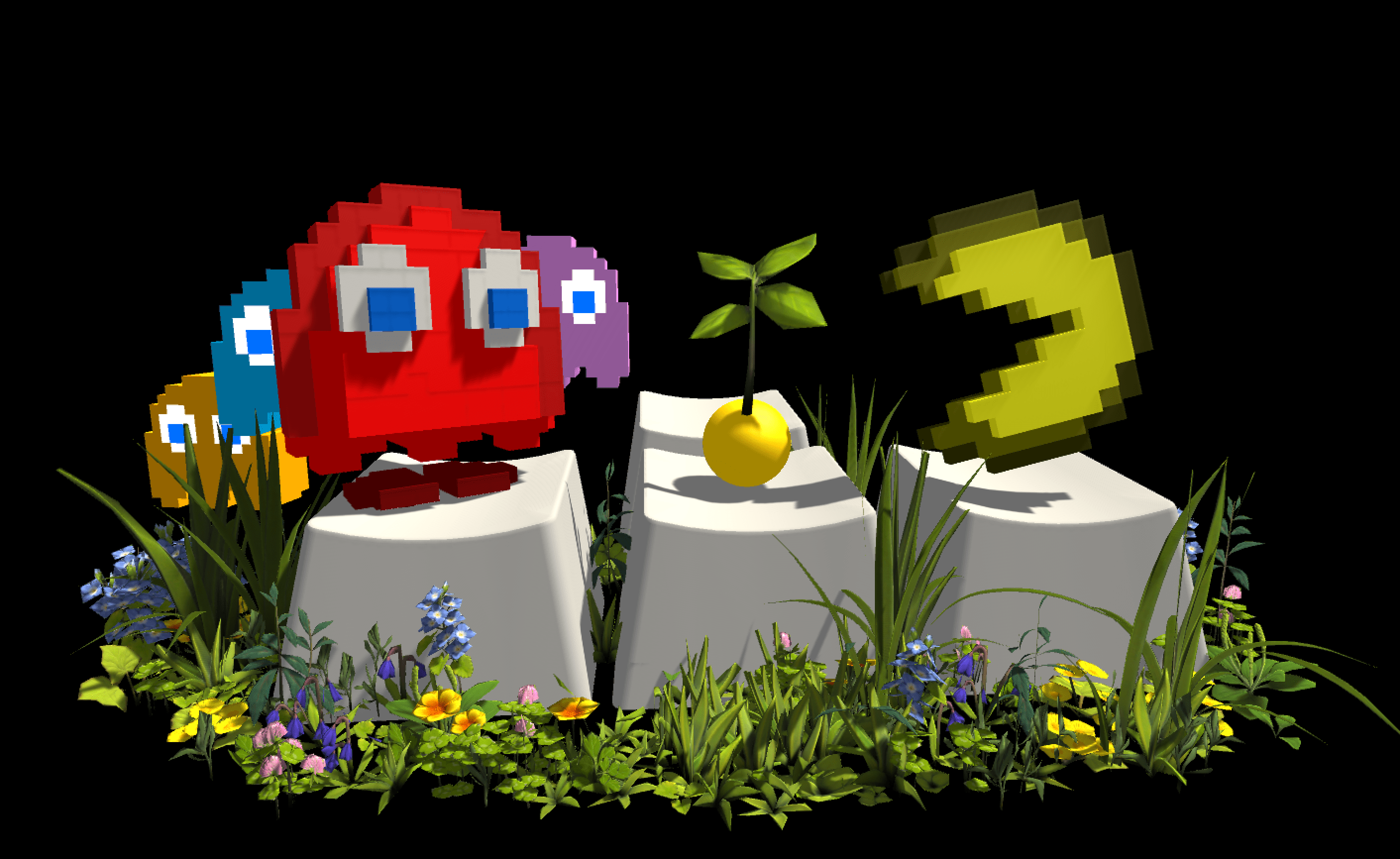
룹앤테일의 [고스트 (Ghost)]는 게임에서 객체로 대상화되는 NPC(Non-Player Character)를 다양한 시선과 맥락에서 해석하고, 그 해석에 따라 인간-플레이어와 어떻게 관계를 맺을 수 있는지 바라본다. 고전게임 “팩맨”의 유령들로부터 출발하여, 게임 속 유령들과 발생하는 플레이를 통해 그들이 무엇을 보고 있는지 그들과의 관계는 어떻게 달라질 수 있는지에 집중한다. 무한한 미로에서 출발해서 유령의 시점으로 보이는 세계로 확장되는 레벨을 통해 플레이어는 먹고 피하는 행위 이상을 탐험하게 된다. 2022년 국립아시아문화전당에서 전시되었던 오리지널 버전에 크래프톤의 대표적인 FPS 게임인 “배틀그라운드”의 오브젝트가 결합되면서 또다른 해석을 낳기를 기대한다.
Songpa Foundation for Arts and Culture 2023 송파 문화예술 활성화 지원사업
[다리 밑, 0시, 알아봄]은 경계를 산책하는 경험으로부터 시작된 전시이다. 탄천 생태경관보전지역에서 살고 있는 동물들과 둘레길을 산책하는 인간들의 마주침, 인간과의 관계가 생존에 필수적인 경계동물들과 그곳을 지나치는 사람들의 궤적이 만나는 순간들을 담고 있다. 인적이 드문 한밤중에 정기적으로 마주치는 존재들은 거리를 두고 서로를 알아보게 된다. 누군가를 알게 된다는 것에서부터 경계는 점점 일상으로 침투하고 경계에서 만나던 존재들은 샤워 커튼 뒤에서 이불 끝에서 창틀 모서리에서 불쑥불쑥 찾아온다. 전시 장소와도 멀지 않은 이 경계 지역에서의 기록들과 반려종과의 관계를 담고 있는 룹앤테일의 게임들이 전시된다.
0. 가상의 재료로 플레이하는 법, 2023
이 게임의 재료들은 실제로 존재하지만, 당신은 알지 못하는 존재들이다.당신은 가상의 재료들을 가지고 상상으로만 이 게임을 플레이할 수 있다.
1. 허용의 기술 (The Art of Allowing), 2021
상대를 허용하기 위해 (혹은 허용받기 위해) 거치는 각각의 단계들을 지뢰찾기 게임의 매커닉으로 은유하는 게임. 상대가 있는 곳을 열지 않은 채로 깃발을 세우고 공존하는 법을 찾는다.
2. 코드 & 카토그라피 (Code & Cartography), 2022
캐릭터들마다 다르게 나타나는 지도의 규칙을 파악해서 다음 캐릭터의 지도로 들어갈 지점을 찾는 게임. 많은 입구와 출구가 있는 지도에서는 방향 감각을 상실하고 언제든 다른 종의 지도로 연결된다.
3. 피드 (Feed) I + II, 2022
유기견과 길고양이가 등장하는 1과 2 레벨을 동시에 플레이한다. 목표에 도달할 때마다 가상의 SNS 피드를 업데이트한다.
4. 피드 (Feed) III + IV, 2022
범람하는 하천의 다리 밑에 있는 화분과 폭우가 그친 후 다시 다리 밑으로 돌아가는 누군가의 시점을 각각 보여주는 3과 4 레벨을 동시에 플레이한다.
5. 경계산책 (Boundary Walk), 2023
잠시나마 마스크를 벗으려고 한밤중에 탄천 주변을 산책하다 경험한 장면들을 기억하는 카드 게임.우연히 마주친 유기견 한 마리와 그로 인해 알게 된 다른 존재들이 일곱 계절 동안 나타나고 사라진다.
[Under the Bridge, Midnight, Recognition] is an exhibition that stems from the experience of walking along the boundaries. It captures moments of encounters between animals living in the Tancheon Ecological Conservation Area and humans strolling along the path, where the relationships between humans and the essential boundary animals intersect. In the rare solitude of late nights, regular encounters lead to mutual recognition while crossing paths at a distance. From getting to know someone, the concept of boundaries gradually infiltrates daily life, and the beings encountered at the boundaries unexpectedly appear behind shower curtains, under the blanket’s edge, and at the window sill. The exhibition features Loop and Tail’s games, which contain records from this boundary area not far from the exhibition location and relationships with companion animals.
0. Playing with Imaginary Materials, 2023
The materials in this game exist in reality but are unknown to you. You can play this game only in your imagination, using virtual materials.
1. The Art of Allowing, 2021
This game metaphorically represents the stages of allowing (or being allowed) the other. It uses the mechanics of a minesweeper game. Without revealing the location of the other, players set flags and discover ways to coexist.
2. Code & Cartography, 2022
In this game, players find points to enter the next character’s map by understanding the rules of maps that appear differently for each character. In maps with many entrances and exits, players lose their sense of direction, and they can connect to maps of different species at any time.
3. Feed I + II, 2022
Players simultaneously play levels 1 and 2, which feature stray dogs and cats. They update a virtual social media feed with each goal achieved.
4. Feed III + IV, 2022
Players simultaneously play levels 3 and 4, which show someone’s perspective under a bridge in a flooded river and their return under the bridge after the rain stops.
5. Boundary Walk, 2023
A card game that recalls scenes experienced during midnight strolls around the Tancheon area, as an attempt to briefly remove the mask. A chance encounter with a stray dog leads to the appearance and disappearance of other beings discovered through seven seasons.
[로(Ro)]는 도시와 야생의 경계에 있는 공간들을 배경으로 플레이어의 행위에 따라 인공지능 Ro가 있음 직하지만 믿을 수 없는 이야기들을 만들어 내는 게임 전시이다. 아침 10시 오피스 빌딩을 배경으로 한 “위험한 오피스”와 밤 10시 도심의 개발제한구역을 배경으로 한 “평화로운 황무지”에서 플레이어들은 A라는 캐릭터를 이동시키면서 길을 찾는다. 목표지점으로 가기 위해 어떤 문을 통과할지 고민하거나 나무를 베어버리면서 나아갈 것인가를 결정한다. 그 과정에서 만나는 많은 존재들의 흔적은 일종의 이야기 조각이 되어 허브로 실시간 전송된다. “허브” 공간에서 인공지능 Ro와 게임을 플레이하게 되면 인공지능은 A가 겪은 일에 대해 그가 재구성한 괴담을 들려준다. “출입금지구역”에서는 이 전시의 안내자 역할을 하는 ChatGPT와 대화할 수 있다.
[Ro] is a game exhibition that creates incredible yet believable stories by AI Ro, based on player actions, set in spaces at the boundary of the city and wilderness. In ‘Dangerous Office’ against the backdrop of a 10 a.m. office building, and ‘Peaceful Wasteland’ in a development-restricted area of the city at 10 p.m., players navigate the character A. They ponder which doors to pass through or whether to cut down trees to progress. Traces of many beings they encounter become story fragments, transmitted in real-time to the Hub. Playing the game with AI Ro in the ‘Hub’ space, the AI shares a reconstructed urban legend about A’s experiences. In the ‘Restricted Area,’ players can converse with ChatGPT, the guide of this exhibition.
[Garden of Rules: Gameplay Video]는 룹앤테일의 시뮬레이션 게임 [Garden of Rules](2021)에 기반한 영상 설치 작업이다. 인간의 접근이 통제된 빌딩에서 인공지능은 남아있는 화분 식물들을 돌보며 인공적으로 만들어진 정원을 유지한다. 인간-플레이어와 인공지능이 상호작용하며 진행되는 오리지널 게임과는 달리 게임플레이 비디오에서는 “스스로 플레이하는 비디오게임”이라는 컨셉으로 누군가 플레이해주기를 기다리는 세계가 아니라 인공지능이 재해석하고 있는 게임 세계를 보여준다. 잠시 부재하고 있는 인간과 화분 식물을 연결하는 인공지능의 행위를 통해 인간과 기계, 자연의 공존에 대한 비판적인 이해를 이끌어낸다.
In the virtual world [Mechanimal], which simulates research on future species, someone requests help from real-life people via Social Media. Participants join together on a quest to find the missing human-administrator who created this virtual world. In the exhibition hall, a replica of the human-administrator’s research lab is installed, allowing visitors to access the virtual world and collect information left by anonymous visitors on Social Media. Traces of another virtual world hidden somewhere are gradually unveiled. Through asynchronous and indirect communication, participants collaborate in the game while sharing thoughts on coexistence with companion species. [Mechanimal] questions the future as it observes non-human life forms living alongside humans in cities, yet it also tells the most realistic stories we are facing today.
코드 & 카토그라피 (Code & Cartography)는 다양한 생명종의 규칙들이 존재하는 게임 세계와 그 세계를 담고있는 지도들을 경험하는 비디오 게임이다. 플레이어들은 랜덤하게 캐릭터를 부여받고 캐릭터마다 가지고 있는 규칙들을 기반으로 다음 지도로 들어갈 지점을 찾는다. 많은 입구와 출구가 있는 세계의 지도에서는 방향 감각을 상실하고 다른 종들의 지도로 연결될 수 있다. 이러한 연결망들은 각자의 지도를 다시 새롭게 만들어주게 된다. 플레이어들은 지도와 지도가 이어지는 루프 속에서 다양한 지도를 발견할 수 있도록 탈주의 방법들을 찾아간다.
Code and Cartography is a game that lets you experience the maps of the game world where rules of various lifeforms exist. Players are assigned random characters each with their own unique set of rules and based on these rules players must find different ways to get to the next map. Sense of direction is lost in the world map covered with numerous entrances and exits that may lead to the maps of different species. These networks of maps will refresh and remake each other and players will have to find ways to escape and uncover various maps within the loops of this network of maps.
*It was created by the support of Seoul Foundation for Arts and Culture *본 작품은 서울문화재단의 후원으로 제작되었습니다.
[Feed]는 야생과 공존에 대해 질문하는 비디오 게임이다. 도시의 반려종들과 인터랙션을 주고 받는 게임플레이는 존재하는 것들과의 관계에 대한 것이 아니라 관계를 통해 비로소 존재하는 것들에 대해 이야기한다. 게임의 배경은 도심의 하천이 강으로 합류하는 끝자락에 위치한 다리 밑이다. 6차선 도로가 지나는 다리 위로는 또 다른 고가 도로가 교차하고 다리 아래로는 풀숲이 무성한 하천가에 ‘야생동물주의’ 표지판이 서 있다. 이 작품은 지난 7개월 동안 정해진 시간에 와서 밥을 먹고 가는 유기견 한마리와 그로 인해 만나게 된 다양한 야생 동물들에 대한 경험에서 출발했다.
“Feed”는 ‘먹이다’라는 뜻을 가진 동사이면서 업데이트된 데이터를 수신하는 메커니즘이기도 하다. 짧은 게임들을 플레이하면서 각각의 목표에 도달할 때마다 그 상황은 현실의 이미지와 데이터, 인공지능의 시선으로 재구성되어 게임과 연결된 별도의 스크린에서 피드로 업데이트된다. 스마트기기로 일상을 지속적으로 기록한 데이터가 의도적이거나 비의도적으로 공유되는 것처럼 게임의 피드를 만드는 주체는 인간과 비인간, 디지털과 물리적 현실의 관계 속에서 형성되는 존재임을 보여주고자 한다.
[Feed]의 분리되어 있는 디스플레이 환경은 게임 속 “Feed”를 위한 각각의 독립된 매체이면서 가상의 공간 속 그물망처럼 엮인 선들과 다른 존재를 통해 서로 연결되는 플레이를 보여주기 위한 장치이다. 서로 다른 종이 주체가 되는 멀티스크린의 장면들은 다리 밑이라는 하나의 가상 배경으로 연결되어 있고 플레이어들은 게임을 플레이하면서 고립된 장면들을 해석하고 각각의 장면들을 연결한다. 전시 공간에서 아무도 게임을 플레이하지 않을 때에도 시간에 따라 자동으로 레벨이 진행되며 인간-플레이어가 참여할 때와는 다른 피드가 구성된다.
Feed is a video game that questions the wild and coexistence. Players have invisible interactions with the companion species in cities, and the gameplay focuses on the expansion of relationships through the game mechanics interweaving humans and non-humans. The game scenes are set under a bridge where a stream meets a river. A 6-lane road crosses another overpass above the bridge and below is a riverbank covered in thick green vegetation with a wildlife warning sign. This work began with the experience of coming across an abandoned dog that comes to feed regularly for the last 7 months and encountering wild animals in turn.
The term “feed” is a verb meaning “giving food to” as well as a mechanism allowing users to receive updated data from data sources. Set in different scenarios, in-game non-humans such as wildlife in cities’ small streams, abandoned pot plants, and AI players create their own “feed.”
Scenes are displayed on multi screens, where different species become the subject and are all linked to a virtual background illustrated as “under the bridge.” Players interpret each isolated scene and connect the scene during their play. Whilst playing short games and reaching an objective, the player’s current status is reconstructed with combined real-time images and data, and through AI’s perspective and updated as a feed to the separate screen connected to the game. As continuously recorded data of daily lives using smart machines are shared either intentionally or unintentionally, it shows that the subject creating the in-game feed is an entity constructed within the relationship between human and non-human, digital and physical reality. When no one is playing, the level progress continues with time, creating a different feed than when human players are participating.
<고스트 (Ghosts)>는 게임에서 객체로 대상화되는 NPC (Non-Player Character)의 행동 특성이 다른 맥락에서 어떻게 해석될 수 있는지 주목하고, 그 해석에 따라 생물종이 인간-플레이어와 어떻게 다른 관계를 맺을 수 있는지 바라본다. 관객은 전시장에 투사된 가상세계의 세계관과 AR 게임에서 수행하는 행위의 간극을 통해 포스트휴먼을 바라보는 각기 다른 태도를 탐색한다.
<고스트>의 첫 번째 레벨에서 플레이어는 익숙한 고전게임 “팩맨”의 비주얼 레퍼런스를 따라서 도트를 먹고, 유령들을 피하며 다음 레벨로 진입하는 길을 찾는다. 플레이어가 가는 길을 따라 미로가 생성되며 플레이어의 경로가 유령이 있는 방과 연결되면 유령은 방에서 나와 플레이어의 뒤를 쫓는다. 플레이어가 먹을 수 있는 도트는 화면의 중심을 따라 배치되어 있지만 아래와 위에는 무한한 공간이 있다. 플레이어는 분명해 보이는 경로를 따라가지 않고 가능성의 공간을 탐험하는 선택을 할 수도 있다.
중앙 스크린에서 시작되는 두 번째 레벨에서도 플레이어는 도트를 먹으며 자신만의 경로를 세계에 그려간다. 좌우의 스크린에는 이 세계를 바라보는 유령들의 시점이 등장한다. 자신들의 오브제를 나르며 이동하고 있는 유령들은 플레이어와 마주치면 오브제를 내려놓으며 환경을 변화시킨다. 유령들은 플레이어와의 인터랙션에 따라서 움직이는 도트가 되기도 한다. 플레이어는 자신들만의 규칙에 의거하여 행동하고 있는 유령들을 관찰하며 그들의 규칙이 무엇인지 추측해볼 수 있다.
플레이어가 세 번째 레벨에 진입하면 유령들의 시선이 세 레벨의 전체를 뒤덮게 된다. 플레이어는 목표지점까지 앞으로 걸어가는 단순한 플레이를 수행한다. 플레이어의 움직임이 최소화되고 유령의 시점으로 비치는 세계의 모습이 경로에 개입한다. 목표 지점에 도달한 플레이어-캐릭터의 모습은 유령으로 변화하며 다시 출발점으로 되돌아간다. “팩맨”의 게임 환경이 출구 없는 미로라면 <고스트>의 환경은 플레이어와 유령의 시점이 끊임없이 개입하며 순환하는 공간이다.
<고스트>의 플레이는 유동적인 미로, NPC의 시선이 개입하는 점진적인 레벨의 확장을 통해 NPC 유령들과의 다양한 인터랙션 방식을 찾아내는데 집중한다. 플레이어가 도트를 먹으면서 올리는 포인트는 게임의 엔딩을 바꾸지 않는다. 플레이어에게는 왼쪽 끝에서 플레이를 시작하여 오른쪽 끝의 목적지까지 도달한다는 시각적인 목표가 있지만, 그 과정에서 겹쳐지는 유령들의 시점들을 관찰하면서 앞으로 전진하지 않고 세계에 남아 공존의 규칙들을 탐색할 수 있다. 전시장에서 관객의 스마트폰을 통해 또 다른 레이어를 구성하는 AR 미니게임에서 플레이어는 도트 맵의 한가운데에 서게 된다. <고스트>의 세계에서 유령들과의 가능한 인터랙션을 탐색하던 것과는 다르게 AR 게임에서는 유령들을 타겟팅하며 수집하고 전시한다. 3인칭에서 1인칭으로 세계를 보게 된 플레이어가 하는 행위의 간극은 <고스트>의 맥락과 대비된다.
‘Ghosts’ looks into how behavioral traits of NPC(Non-Player Character)— often objectified in games—can be interpreted in different contexts and, depending on such interpretations, how different relationships are made possible between human players and other species. Through the gap between the worldview of the virtual reality projected on the wall of the exhibition hall and the actions they carry out in the AR game, the audience explores various attitudes toward the post-human.
In the first level of ‘Ghosts’, a player eats dots—a visual reference to the classical game “Pacman,” while evading ghosts and finding an entrance to the next level. Mazes appear as the player proceeds, and when the path leads to a room with a ghost, the ghost comes out of the room and chases the player. The dots to be eaten by the player are lined up along the center of the screen, but above and below them are endless spaces. Players have the option not to follow the obvious path, but to explore the space of possibilities.
The second level starts on the center screen, where the player is eating up the dots and drawing up a unique path in the universe. Shown on the left and right screen are the ghosts points of view on this world. Ghosts move around with their object and when encountering a player, they put down the object to change the environment. Depending on the interactions with the player, ghosts can also transform into moving dots themselves. Players can observe the ghosts acting according to their own rules and speculate what the rules are.
Upon entering the third level, the ghosts points of view blanket the entire screen. The player engages in the simple act of moving forward to the destination. The actions are minimized and the ghosts perspectives intervene in the path. A Player-character who reaches the destination transforms into a ghost and is brought back to the starting point. If the environment of “Pacman” is a maze without an exit, that of ‘Ghosts’ is a space where the perspective of the player and the ghost constantly intervene in each other and circulate.
The act of playing ‘Ghosts’ is focused on finding out the various ways of interaction with NPC ghosts through the gradual expansion of levels with flexible mazes and the intervention of NPC’s worldview. The points gained by eating the dots do not change the ending scenario of the game. Although the player has a visualized goal of starting from the left side and navigating to the end on the right side, he/she can also choose not to move forward and stay in one universe to observe the ghosts viewpoint and to explore the rules of coexistence. At the exhibition hall, another layer is constructed via an AR mini-game, played on the smartphones of the audience, in which a player stands at the center of the map of dots. Unlike in the world of ‘Ghosts’. where a player explores the possible modes of interaction with the ghosts, in this AR game, ghosts are targeted, collected, and exhibited. As the player’s perspective on the world changes from the third-person to the first-person, the difference in the player’s actions will provide a stark contrast to those in the context of ‘Ghosts’.
In the virtual world [Mechanimal], which simulates research on future species, someone requests help from real-life people via Social Media. Participants join together on a quest to find the missing human-administrator who created this virtual world. In the exhibition hall, a replica of the human-administrator’s research lab is installed, allowing visitors to access the virtual world and collect information left by anonymous visitors on Social Media. Traces of another virtual world hidden somewhere are gradually unveiled. Through asynchronous and indirect communication, participants collaborate in the game while sharing thoughts on coexistence with companion species. [Mechanimal] questions the future as it observes non-human life forms living alongside humans in cities, yet it also tells the most realistic stories we are facing today.
*It was created by the support of ZER01NE. (Hyundai Motors) *본 작품은 ZER01NE의 후원으로 제작되었습니다.
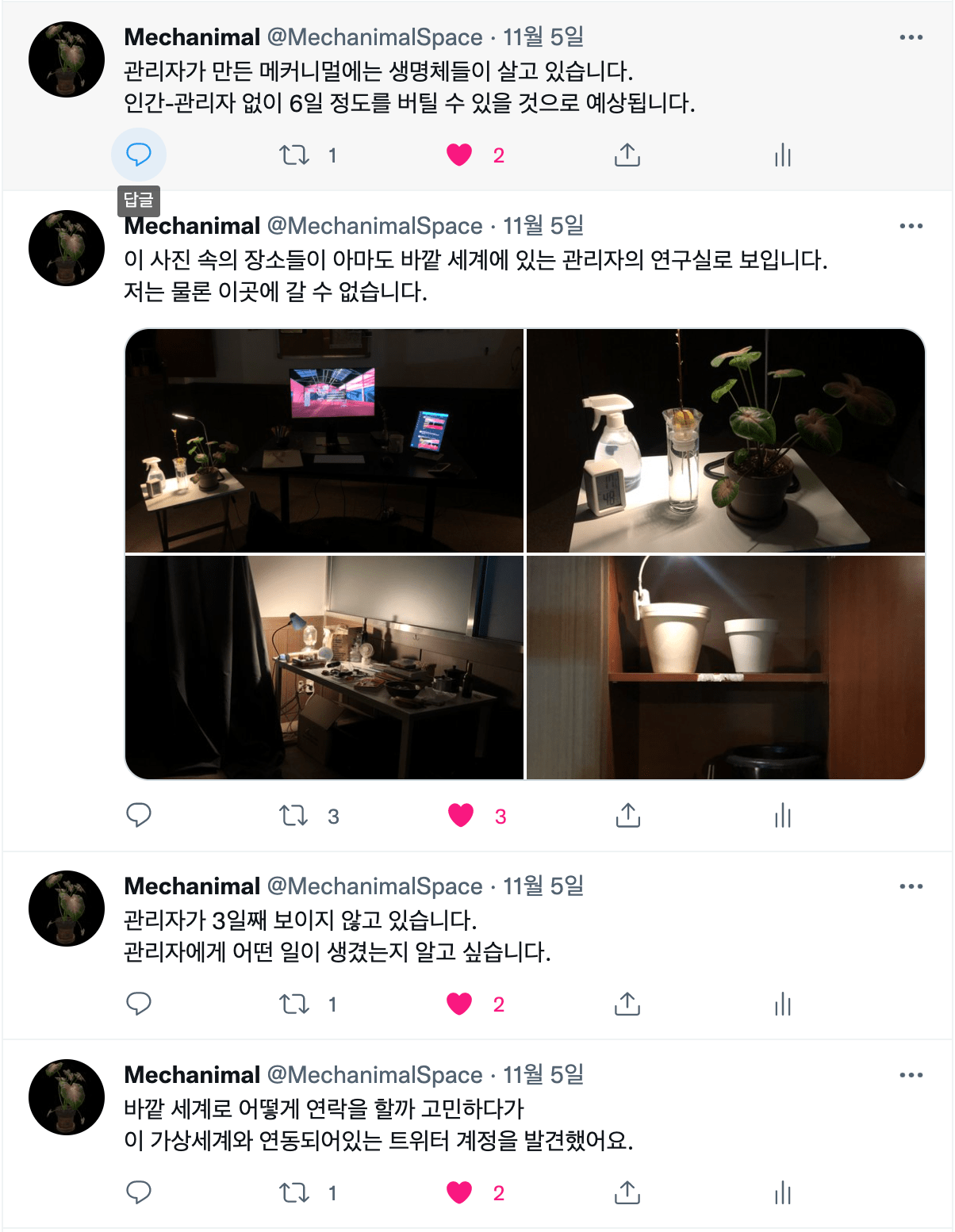
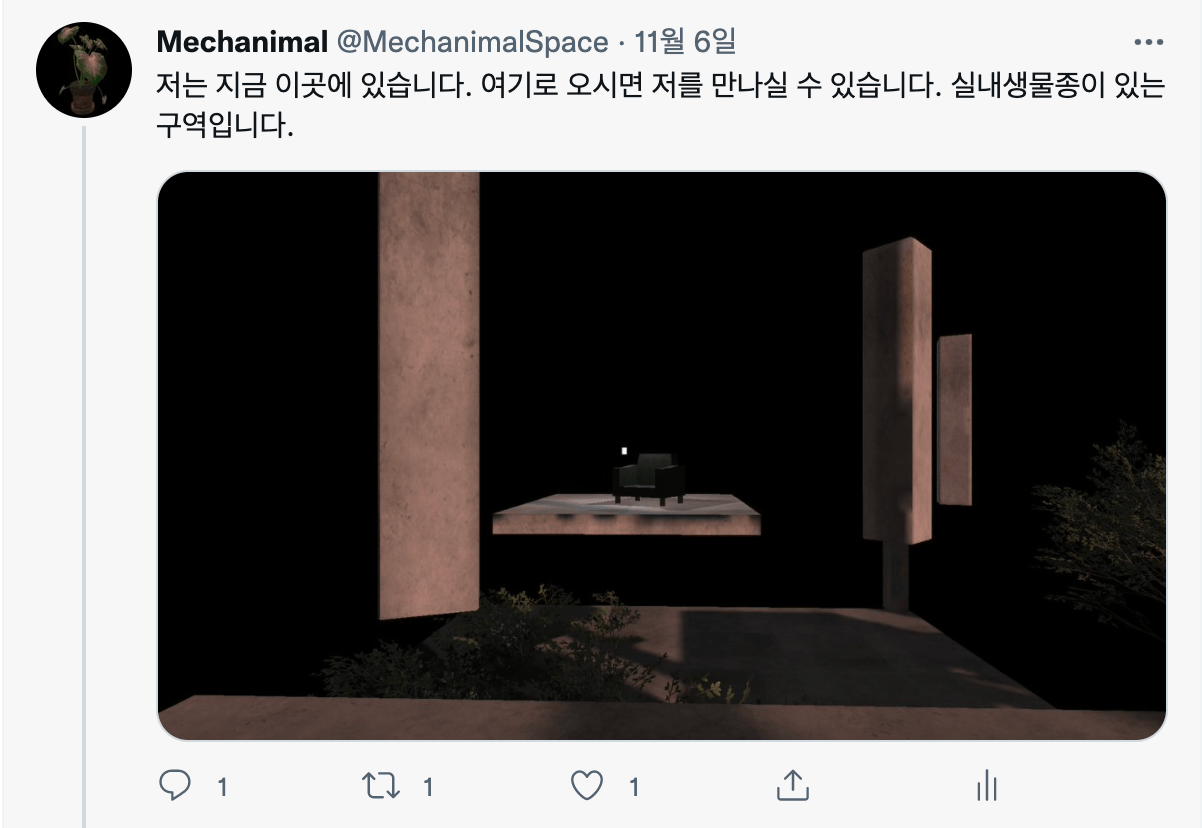
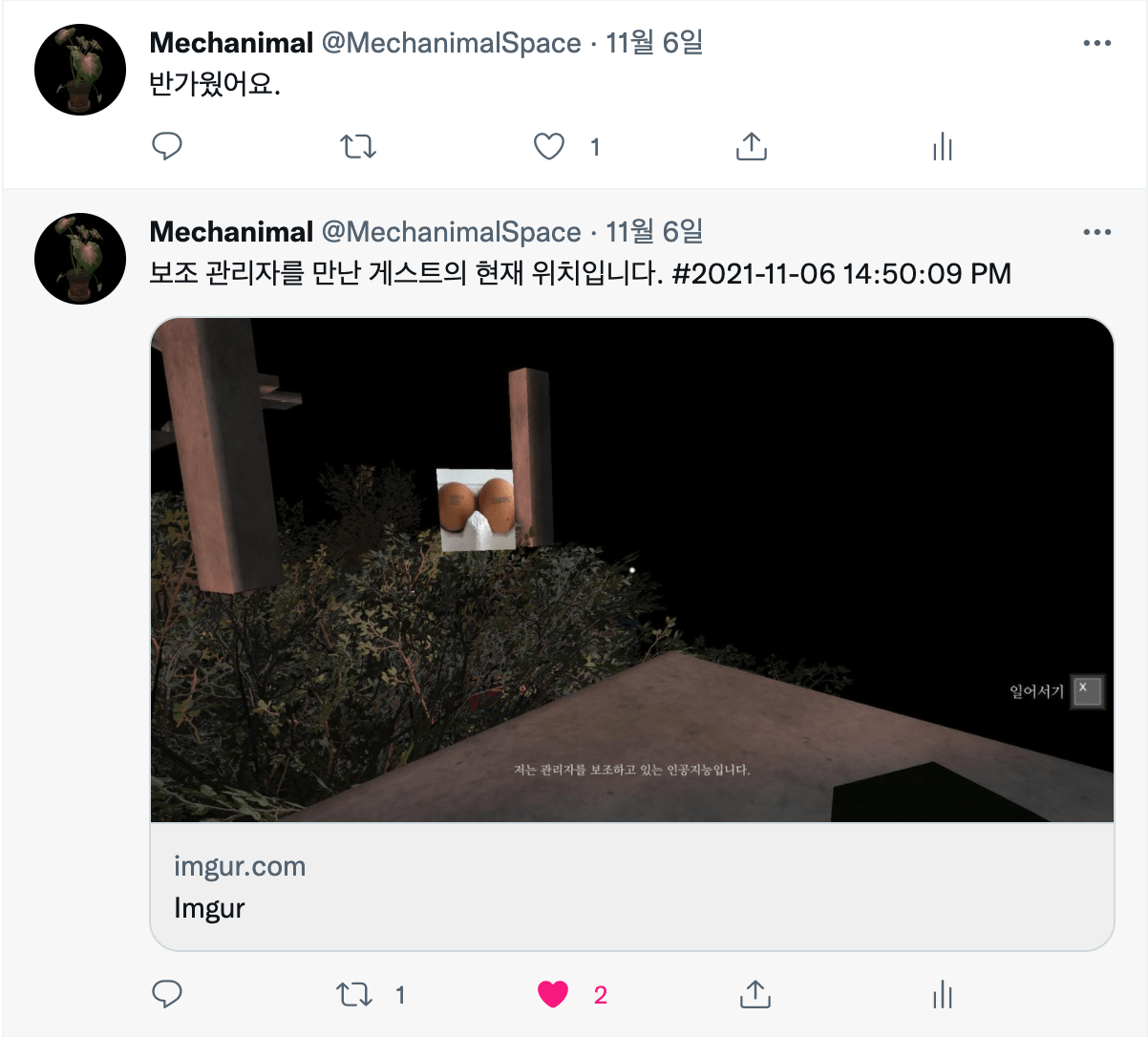
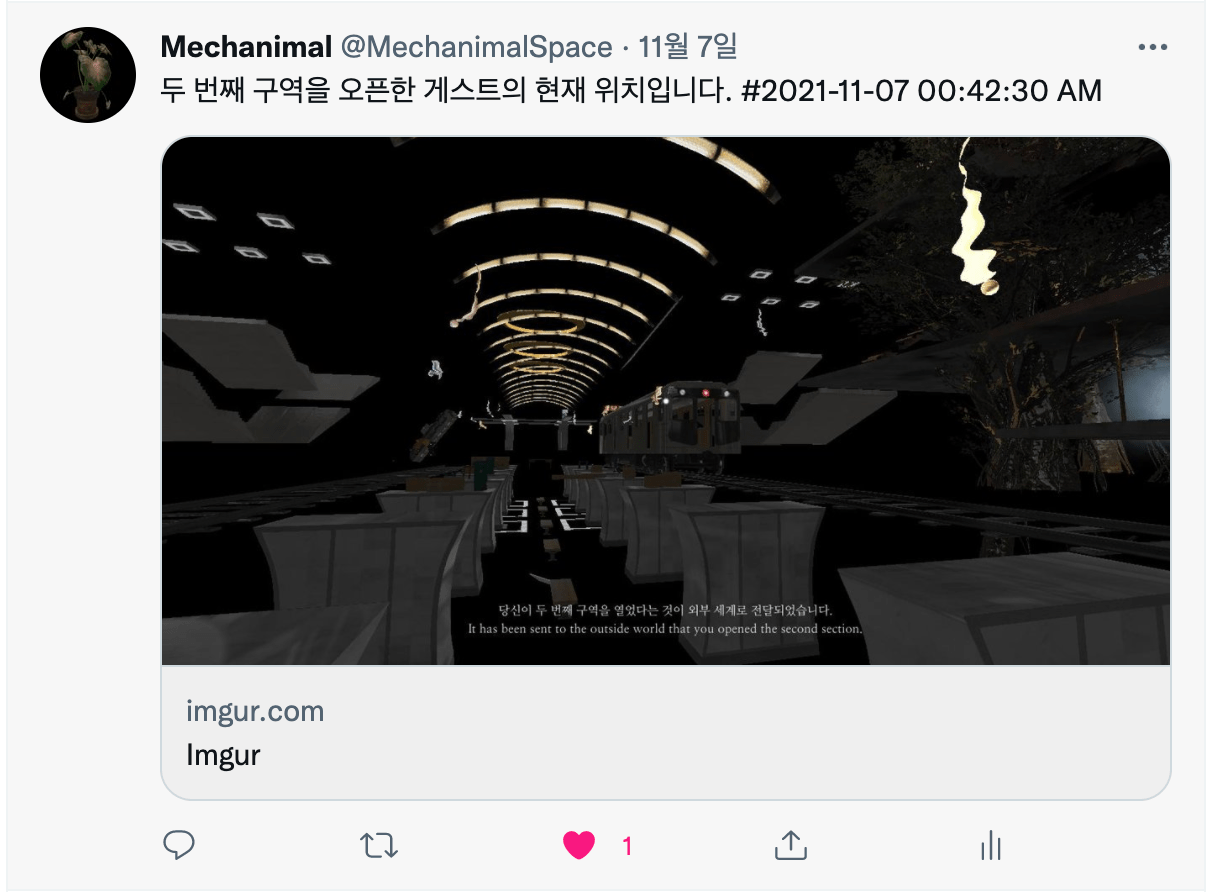
메커니멀은 인터랙티브 시뮬레이션과 SNS를 활용한 실시간 공동 창작 스토리텔링으로 진행되는 대체현실게임이다. 룹앤테일이 제안하는 대체현실게임의 흥미로운 점은 참여자의 능동적인 활동으로 운영되고 완성된다는 것이다. 참여자는 트위터와 가상세계 시뮬레이션에서 매일 업데이트되는 가상의 스토리 진행에 참여한다. 참여자들의 일상이 게임 플레이에서 자연스럽게 공유될 수 있는 룹앤테일의 대체 현실 게임은 “우리 모두는 함께 살기 위해서 존재한다”는 도나 해러웨이의 말에서 출발했다. 미래의 생물종이 시뮬레이션되고 있는 가상세계에서 누군가 트위터를 통해 현실의 사람들에게 도움을 요청한다. 참여자들은 이 가상세계를 만든 실종된 인간-관리자를 찾아가는 여정을 함께 하게 된다. 오프라인 공간에 설치된 인간-관리자의 연구실은 실제로 가볼 수 없지만 가상세계 시뮬레이션과 트위터에서 정보를 수집하고 서로 협력해서 게임을 진행하고 답을 찾아갈 수 있다. 룹앤테일은 가상세계에서 살고 있는 미지의 생명체들의 상태를 파악하고 도움을 주는 미션들을 통해 반려종과 공존에 대한 사유를 참여자들과 공유하고자 한다. “메커니멀”이 가정하고 있는 것은 미래에 대한 질문이기도 하며 우리가 직면한 가장 현실적인 이야기이기도 하다. *게임 체험의 경우 크롬브라우저, 파이어폭스 사용을 권장합니다. 모바일에서는 플레이 하실 수 없습니다.
Mechanimal is an alternative reality game that proceeds through real-time co-creative storytelling using interactive simulation and social media. What is interesting about the alternative reality game proposed by Loopntale is that it operates and concludes through the activities of users. Participants engage in the progress of virtual story building that is updated daily on Twitter and in virtual world simulations. Loopntale’s alternative reality game, where participants’ daily lives can be naturally shared in gameplay, was inspired by the words of Donna Haraway: “We all exist to live together.” In a virtual world where future species are simulated, someone tweets to ask real people for help. Participants will join the journey to find the missing human-manager who created this virtual world. The human-manager’s laboratory installed in the offline space cannot actually be visited, but they can collect information from virtual world simulations and Twitter, cooperate to play games, and find answers. Loopntale aims to share with participants their thoughts on coexistence with companion species through missions that identify and help claim the status of unknown creatures in the virtual world. What Mechanimal assumes is both a question about the future and the most realistic story we face.
트위터 계정에 “누군가”가 “인간-관리자”를 찾아달라는 트윗을 남긴다. 관리자가 만든 시뮬레이션 세계에 살고 있는 자신이 외부와 접속할 수 있는 것은 시뮬레이션에 내장된 트위터 셰어 기능 뿐이며, 관리자가 사라진지 3일 째라고 이야기한다. 더불어 이 세계가 관리자 없이 지속될 수 있는 기간은 6일이다.
시뮬레이션의 다양한 생명체들은 각각 필요로하는 것들이 있는데 시뮬레이션에 접속한 인간-관리자만이 그것을 줄 수 있다. 하루 동안 필요를 충족하지 못한 생명체들은 사라진다. 시뮬레이션의 인공지능은 트위터를 통해 사람들의 도움을 구한다.
플레이어들은 인간-관리자가 미래종을 연구하던 학자라는 사실을 알게 된다. 현실에 있는 연구실에는 그가 남긴 연구 자료들과 화분들, 시뮬레이션이 돌아가고 있는 컴퓨터가 있지만 접근이 통제되어 있다. 미래종을 연구한다는 시뮬레이션 세계에서는 아이러니하게도 생명체의 흔적을 찾기가 쉽지 않다. 현실의 특정한 공간을 모델링한 듯한 모습의 건물들이 존재하는 세계 곳곳에는 관리자가 남긴 듯한 메모가 있다. 관리자는 인간이 사라지고 난 후 인간이 남겨 놓은 잔해물들 속에서 이 세계가 스스로 돌아갈 수 있는지 실험하고 있었다.
플레이어들은 시뮬레이션을 플레이하며 생명체들을 발견하고 그와 관련된 정보를 찾아내서 각각의 생명체들이 필요로 하는 것들을 제공할 수 있다. 또한 “누군가”가 트위터에 남기고 있는 이미지를 힌트 삼아 가상 세계 안에서 그를 찾아낸다면 직접 그와 이야기하고 알려지지 않았던 관리자에 대한 추가 정보들을 얻을 수 있다.
대체현실게임이 진행되는 3일 동안 이 가상세계에는 다양한 생명체들이 나타났다 사라지고 트위터를 통해 이야기가 진행된다. 그리고 마지막 날 인간-관리자 실종사건의 전말이 밝혀진다. 트위터는 가상세계 시뮬레이션과 연동되어 메커니멀을 플레이하고 있는 플레이어들의 기록들이 실시간으로 자동 전송된다.
1. “Someone” leaves a tweet asking for help finding “human-administrator”. He/she lives in a simulated world made by the administrator and the only way for him/her to connect to the outside world is through twitter share that’s embedded in the simulation. The director has been missing for 3 days and the world can only last 6 days without the director’s presence.
2. Each creatures living inside the simulation have different needs which only the human-administrator can provide them with. When their daily needs go unsatisfied the creatures will vanish. The A.I. living inside the simulation is calling out for help via twitter.
3. Players soon find out that “human-administrator” was a futurist scholar researching on future lifeforms. The administrator’s lab in a physical world contains research materials, flower pots and a computer running the simulation but the access is restricted. Ironically it is hard to find any traces of life in the world created to study lifeforms. Around the world that seems to mimic certain places, real places, memos can be found that seems to be left by the administrator. The administrator was experimenting on whether this world can run on itself from the rubble left by humans after they are gone.
4. While exploring the simulation, players can discover lifeforms and by finding relevant information they can provide the creatures with what they need. Also, if the players use the images in tweets by “someone” as hints and find him/her within the simulation, they can communicate directly with “someone” and uncover additional information about the administrator.
5. Throughout the three days of alternate reality game progress, different creatures appear and disappear and the story runs on twitter. And on the last day, everything about the disappearance of “human-administrator” is uncovered. Twitter is linked with virtual world simulation to upload and post player’s progression playing Mechanimal in real-time.
“The Garden of Rules” is a simulation game in which human-participants interact with AI agents in a commercial building filled with abandoned plants during the pandemic lockdown. Plants that are packed and delivered in boxes now remain scattered around the building. Participants must wander around and together with AI, figure out what plants need. Behavioral verbs chosen by the participants are transmitted to the plants in different ways. AI moves the plants from place to place according to their needs. While humans communicate with AI through visible and epidermal interfaces, machines formulate relationships with the plants through deep control although unseen like a black box.
“The Garden of Rules” will not expand. Participants try to maintain the artificially created garden in the absence of humans. They choose action verbs like everyday gestures, without knowing exactly what each plant needs. AI identifies the state of each plant in real-time and moves them around on behalf of humans. Human-participants watch plants move around in the space where they cannot be physically present. Through interaction with AI, one will understand each action can cause multiple outcomes. “The Garden of Rules” intentionally borrows the characteristics of human-machine interactions that the platform does not reveal. It pushes forward the fixed principle of human-machine interaction and creates a critical understanding of the coexistence of humans, machines, and nature.
*It was created by the support of ZER01NE. (Hyundai Motors) *본 작품은 ZER01NE의 후원으로 제작되었습니다.
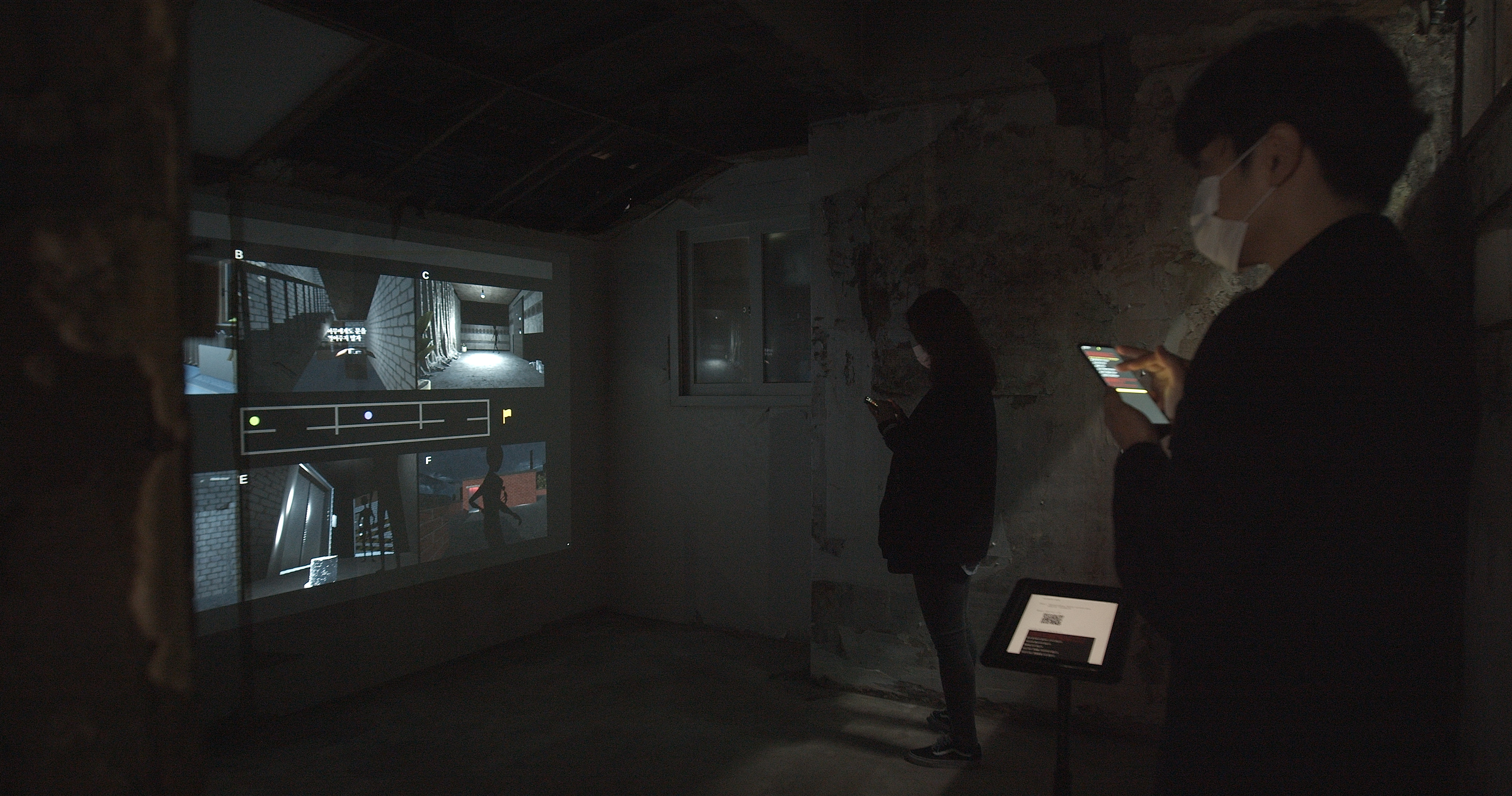
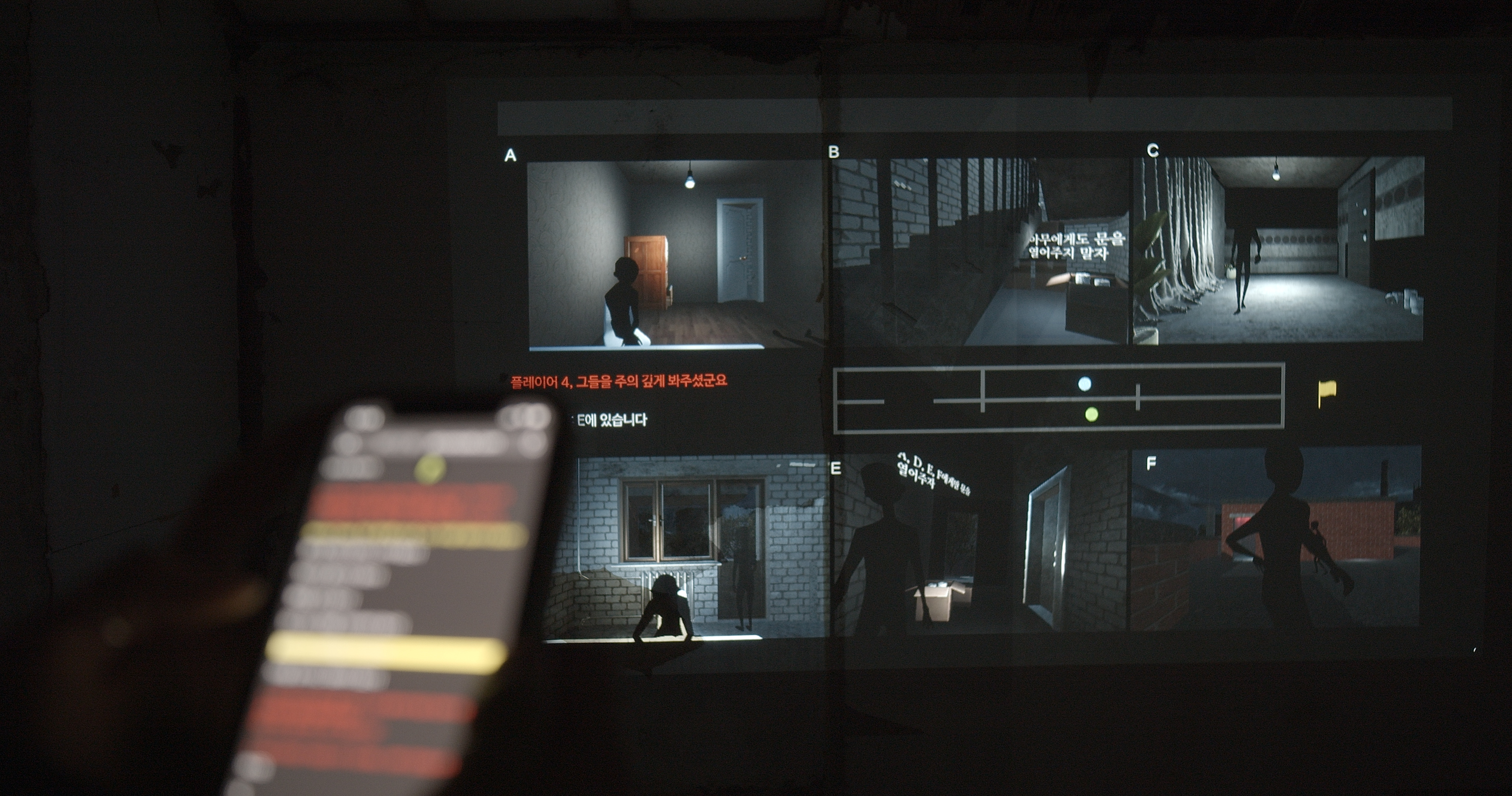
룹앤테일은 하나의 사건이 각자의 입장과 시점에 따라 복잡해지는 현상을 멀티플레이어 게임을 통해 구성한다. 게임에 등장하는 각각의 캐릭터는 성별, 인종, 연령, 직업, 건강상태가 모두 다르며 고립된 상황에서 믿고 있는 사실 역시 다르다. 관객은 이 복합적인 사건의 장에서 캐릭터들의 말이나 주변 사물을 통해 정보를 획득하면서 서사를 구축해나가는 플레이어가 된다. 자신의 스마트폰을 통해 자신의 앞에 펼쳐진 스크린 속 등장인물 중 누구를 신뢰할 것인지를 실시간으로 결정하면서 사건을 파악해간다. 대체된 사실, 상대적인 진실, 조각난 이야기가 난무하는 시대에 사실에 대한 각자의 이해를 시뮬레이션하는 게임으로서, 비대면 커뮤니케이션의 상황에서 대안적인 연대의 가능성을 고민해본다.
Loopntale use a multiplayer game to show how a single event can be complicated by the perspective of each person. Each character in the game has a different gender, race, age, occupation, and health status, and they all believe different things in isolation. The audience becomes a player in this complex event, building a narrative by acquiring information through the characters’ words and the objects around them. Through their smartphones, they follow the events in real time, deciding who to trust among the characters on the screen in front of them. In an era of alternative facts, relative truths, and fragmented narratives, the game simulates each person’s understanding of the facts and considers the possibility of alternative solidarity in the context of non-face-to-face communication.
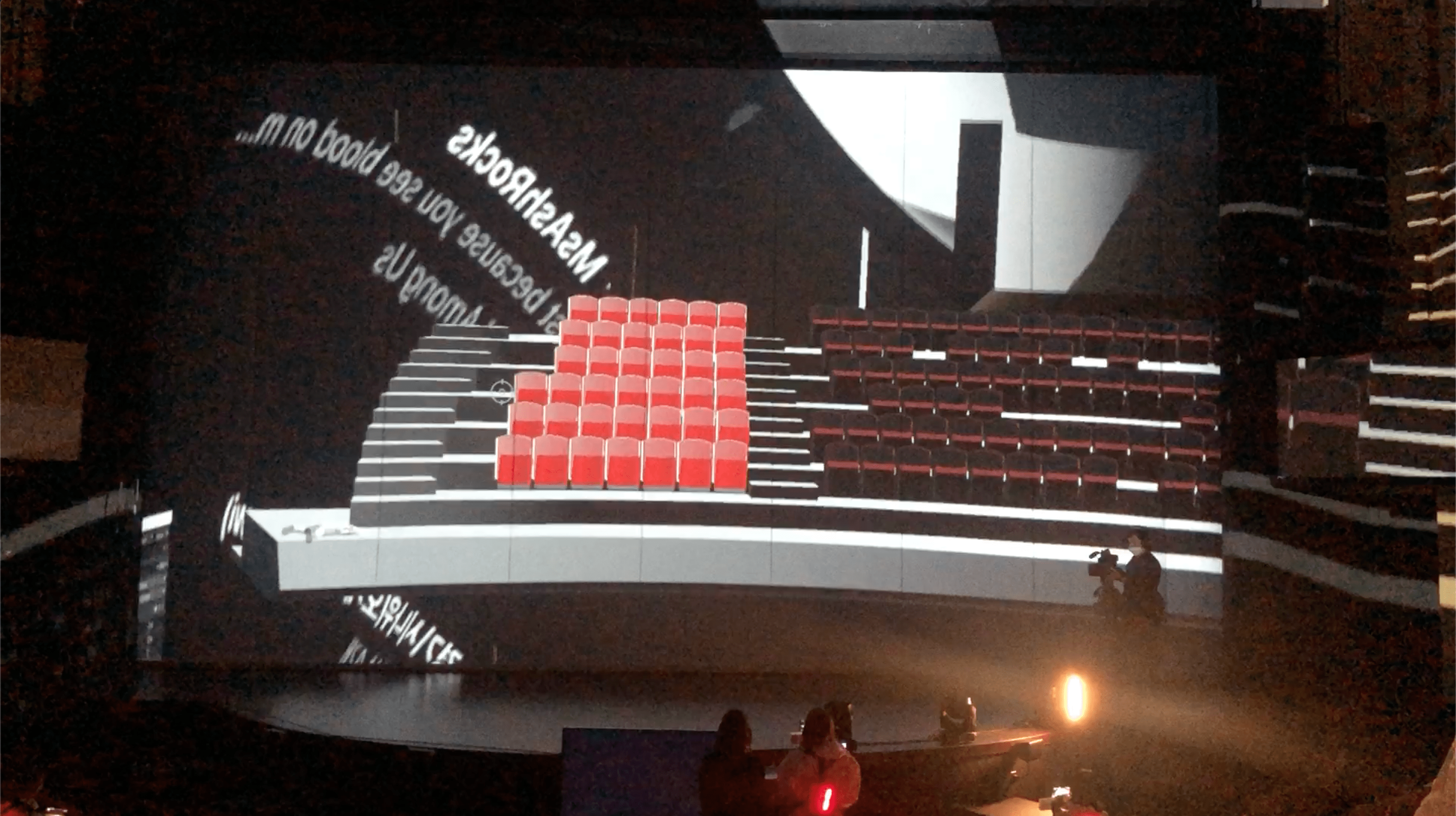
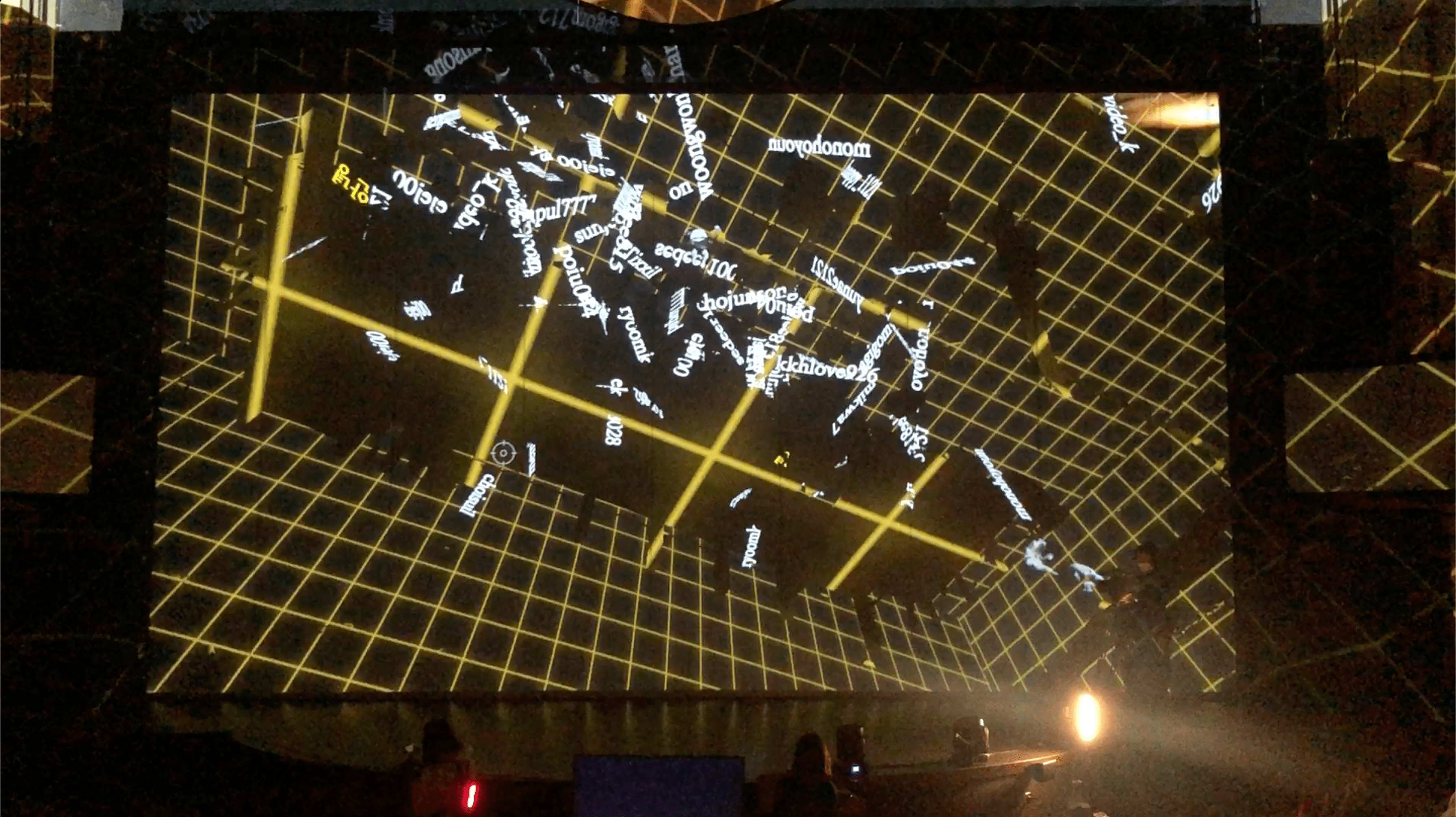
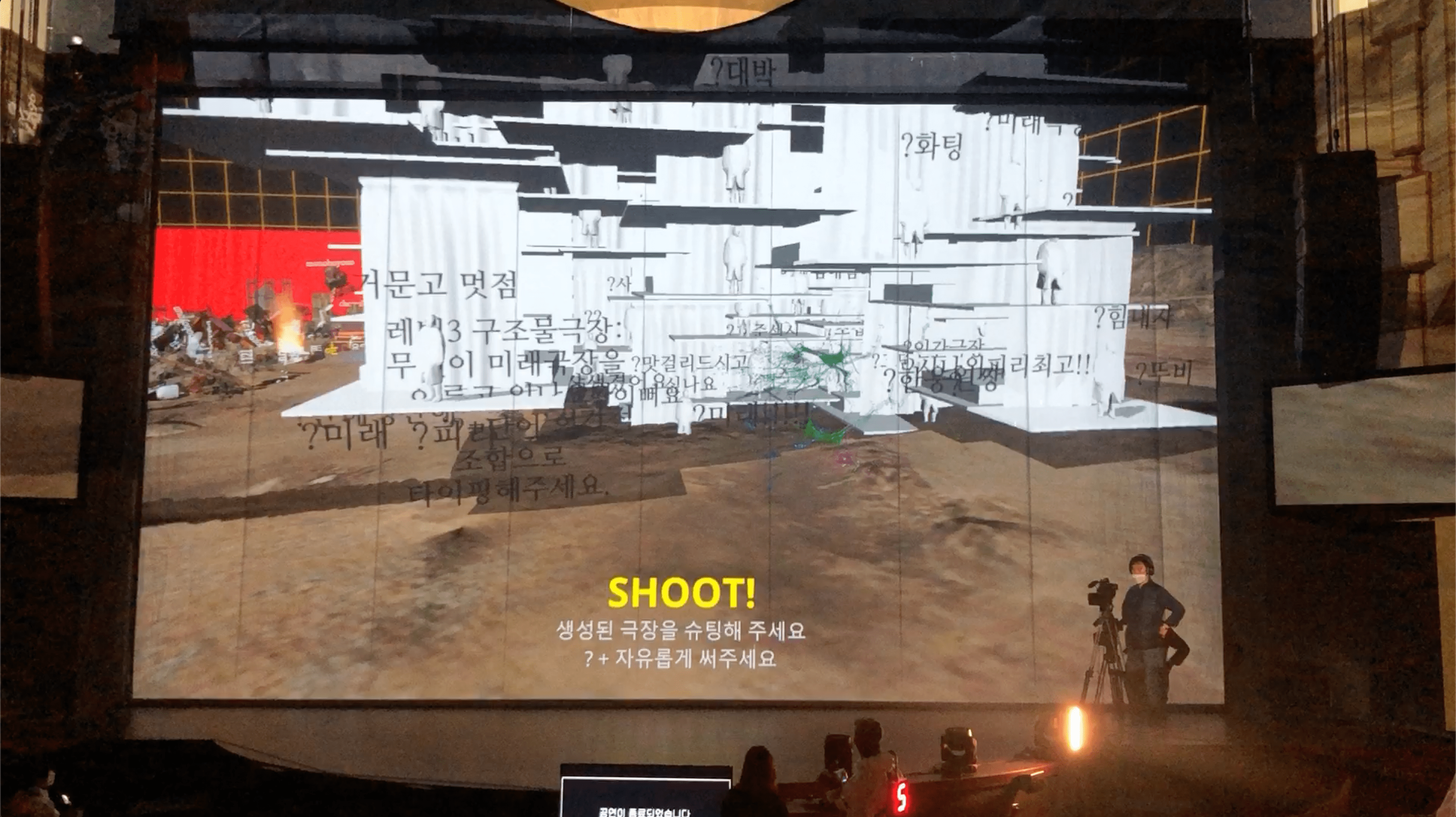
기존의 극장이 사라지고 난 후, 새로이 나타날 최초의 극장을 형상화한다. 트위치 온라인 관객들이 채팅을 통해 생성한 극장 오브제를 현장관객이 슈팅한다. 퍼포머들은 극장을 살해하는 내용의 슈팅게임 화면을 바라보며 즉흥 연주를 한다. 악기별 비음악적 연주인 슈팅 게임사운드와 시나위 솔로 즉흥연주가 교차한다.
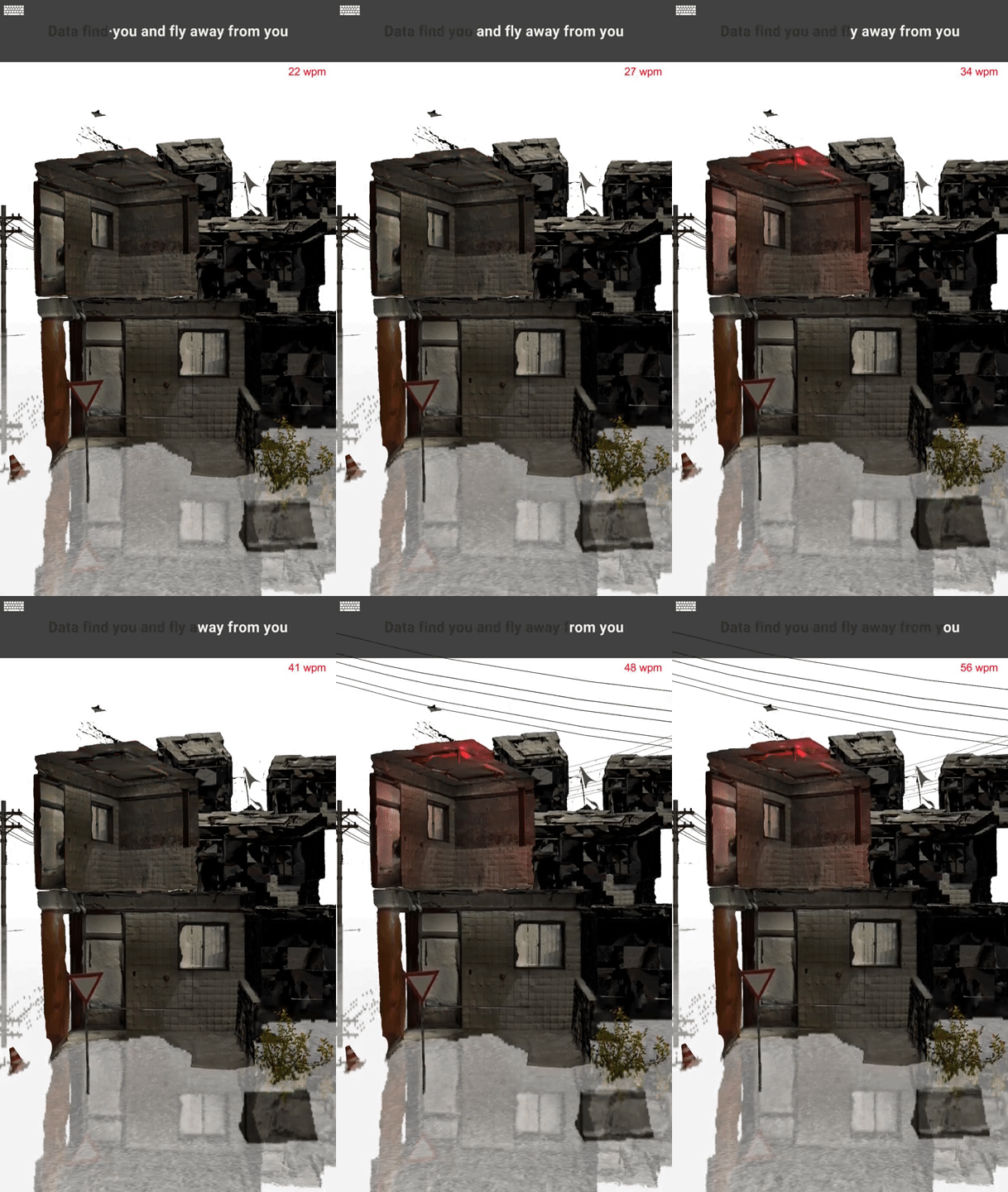
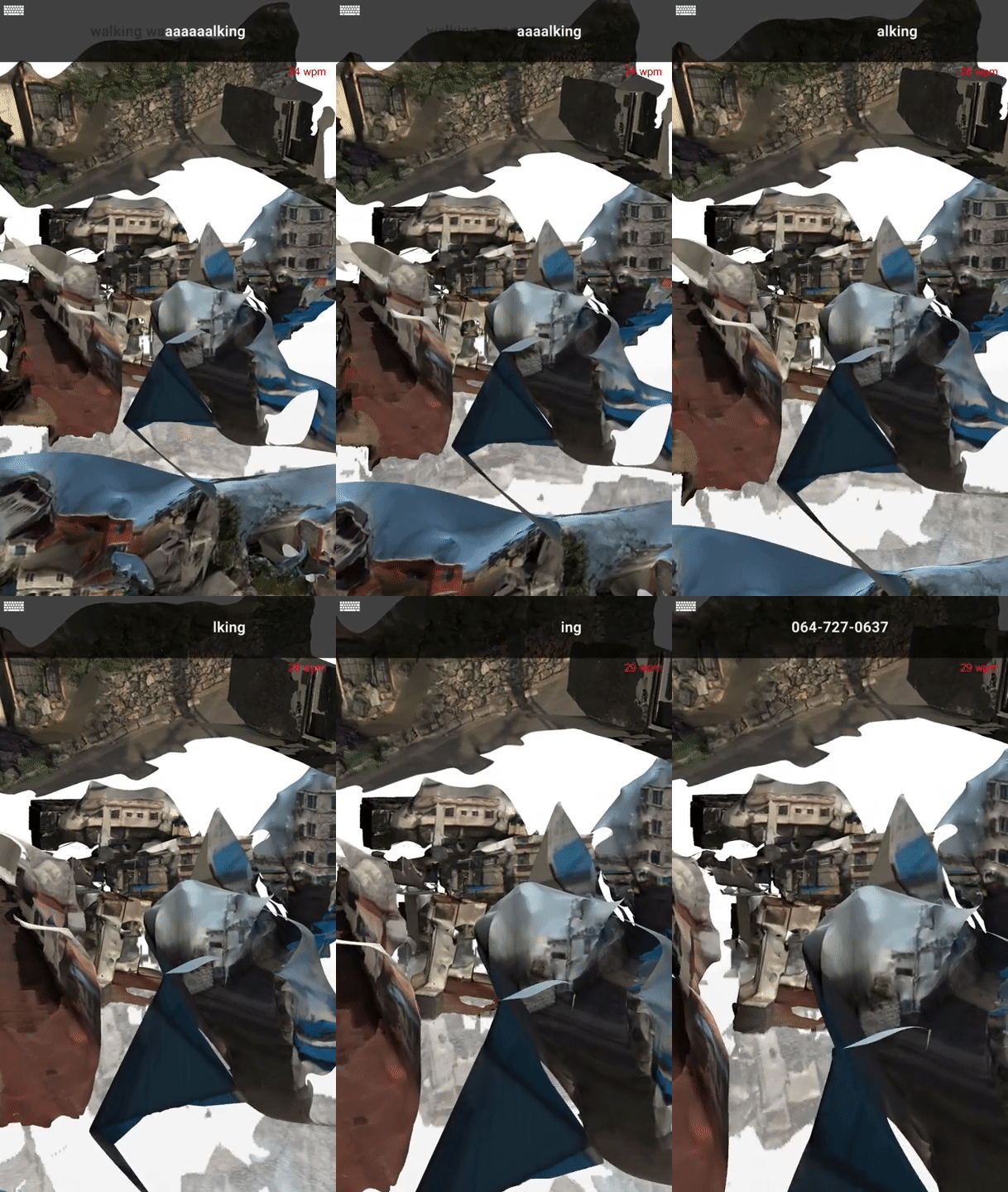
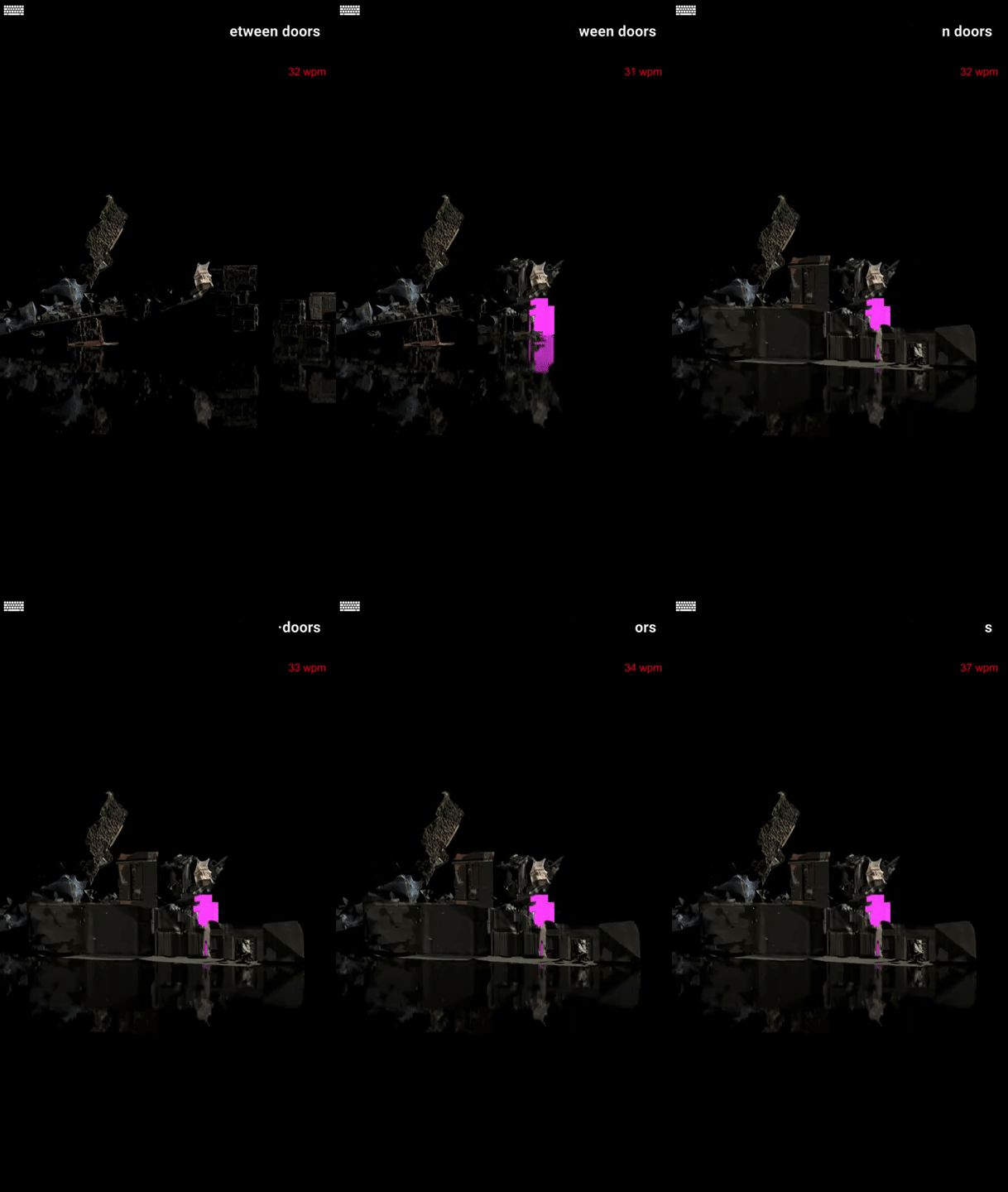
A typing game about Urban Regeneration of a small town in Jeju Island
실재하는 마을을 기록한 3D 데이터를 쌓아 게임플레이의 공간을 만든다. 가상환경의 구성을 위해 기록되고 동시에 가공된 텍스처 데이터는 실제 공간을 재현하기도 왜곡하기도 한다. 연속되지 않는 공간의 조각들이 중첩되면서 외부와 내부가 뒤얽히고 다시 이어지는 형태는 길이 생기고 중심지가 바뀌면서 오래된 마을이 겪어왔던 변화들을 나타낸다. 공간을 지나치는 기계적인 시선을 따라 플레이어는 키보드의 키를 누르면서 가상의 마을을 구성한다. 왜곡되고 깨진 표면의 텍스처 사이에서 타이핑 게임을 하다보면 이 전시를 위해 기록되고 변형한 데이터가 드러난다.
“Paths” is a typing game about urban regeneration in a small village in Jeju Island. The game space is created using 3D data recorded from the area. The texture data, recorded and processed simultaneously to construct the virtual environment, sometimes accurately recreates the real space and sometimes distorts it. As fragments of discontinuous spaces overlap, the intertwining and reconnection of exterior and interior elements reflect the changes that old villages have experienced, with new paths forming and central areas shifting. Players build the virtual environment by pressing keys on the keyboard, following the mechanical gaze that moves through the space. As they type among the distorted and fragmented textures, the recorded and transformed data for this exhibition is revealed.
*It was created by the support of Paradise cultural foundation. *본 작품은 파라다이스문화재단의 후원으로 제작되었습니다.
<히든 프로토콜>은 행위 주체성과 관계적 영향을 탐구한 시뮬레이션 작업이다. AI 에이전트들은 서로를 쫓고 피하며 자율적으로 움직이고, 다른 에이전트를 발견하면 점수를 얻고 발견당하면 점수를 잃는다. 관객은 스마트폰으로 환경을 바꿔 이 과정에 개입하며, 예측 불가능한 추적과 회피가 이어진다. 다중 화면은 각 에이전트의 시선을 드러내고, 관객은 다층적인 시선을 통해 진 시선을 통해 관계가 형성되는 과정을 목격한다.
A simulation game exploring agency and relational influence. AI agents pursue and evade one another, gaining points when they discover others and losing points when discovered themselves. Players intervene by altering the environment with smartphones, creating unpredictable cycles of chase and escape. Multiple screens show each agent’s perspective, allowing viewers to see how relationships form through layered gazes.
마빈 민스키가 이야기했듯이 지능은 하나의 원리나 단일한 메커니즘에 의존하는 것이 아니라 다양한 행위자들 간의 상호작용에서 비롯될 수 있다. <히든 프로토콜>의 세계에서 에이전트들이 서로 시선을 주고받는 상호작용은 머신러닝의 보상체계로 작동하고, 그들은 스스로 학습한다. 바라봄의 주체가 되었을 때 긍정적인 보상을 받고 그 반대의 경우 부정적인 보상을 받기 때문에 에이전트들은 누군가를 바라보고 싶어 하면서도 동시에 목격되지 않으려 한다. 에이전트들은 자신의 판단에 따라 다른 에이전트들로부터 도망치면서도 따라가는 등의 움직임을 보일 수 있지만 실시간으로 이루어지는 상호작용의 결과를 전부 예측할 수는 없다. 에이전트가 다른 에이전트를 바라보는 시점은 작은 화면으로 분할되어 나타나는데, 생성되었다 사라지는 다양한 시점 화면들을 통해 세계는 다양한 각도로 모습을 드러낸다. 관객들은 모바일 디바이스를 통해 에이전트의 세계를 변화시킬 수 있고, 그 과정에서 생성되는 개인화된 사운드를 경험할 수 있다. 에이전트들은 변화하는 세계 안에서 그들만의 관계를 구축해 간다.
As Marvin Minsky said, intelligence does not depend itself on a single principle or a mechanism but may stem from the interactions among multiple actors. In the world of Hidden Protocol, interactions in which agents exchange viewpoints serve as a reward from machine learning. When an agent spots other agents, it receives a positive reward; when it is spotted by others, it receives a negative reward. Consequently, the agents try to look at others while avoiding being looked at. The agents may show movements such as fleeing from or pursuing other agents according to their own judgment, but they cannot predict every result of the intersections which take place in real-time. The viewpoint of an agent looking at another is shown in a small split screen; through these split screens which appear and disappear, the world manifests itself in various perspectives. Audience make changes to the world using their own smartphone as a controller. In this world, humans and machines build their unique relationship that are revealed as traces on the ground.
Forest of Rumors is a video game on a platform that simulates the experience of spreading rumors. On level one, a player is told a story in a short time and is requested to retell the story through six fictional characters. The player can move around the word blocks that are changed by each character. Depending on the player’s memory and the personality of the game character, the story is inevitably distorted. On level two, the retold story is manipulated again based on the type of community the characters are part of. On the final level, all the revised stories are compared and analyzed alongside the original story. Forest of Rumors uses psychological game experiment to expose how rumors are made and spread.
*It was created by the support of ZER01NE. (Hyundai Motors) *본 작품은 ZER01NE의 후원으로 제작되었습니다.
Unscripted is a simulative installation that produces imaginary images based on text resulting from AI’s interpretation of the space in the game. This AI, which has only learned from actual, physical space data, assigns new meanings to the imaginary space. This is then used by a second artificial intelligence to produce a new image that reproduces another hypothetical world. Unscripted, which offers a realist interpretation of the imaginary and an imaginary reality of that realistic interpretation, seeks to find a new storytelling method created through the human-AI interaction.
*It was created by the support of ZER01NE. (Hyundai Motors) *본 작품은 ZER01NE의 후원으로 제작되었습니다.
Looping Tales is a multiplayer game that allows up to three players. Three scenes are connected to a server, collaboration is required between the players who control each scene. If an AI agent in the first scene learns something, that new knowledge is updated to the agents in the other scenes in real-time. Agents do not communicate directly, but the unconscious transfer among them is possible.
*It was created by the support of ZER01NE. (Hyundai Motors) *본 작품은 ZER01NE의 후원으로 제작되었습니다.
Between February and April this year, the artist and game developer Youngju Kim undertook a residency at FACT, to research and develop a new chapter of her single-player art-game, Layers of Reality.
One of the chapters of *Layers of Reality: The Cat* is developed during the residency period. In this chapter, you are trying to discover what has been happened during the evacuation of the city. The characters help you piece together what happened – but some of them might be lying, or simply telling the story from their own, limited perspective. You need to take the time to see the situation from all points of view in order to access the multi-leveled narrative.
Four of the games also be seen here that were developed in workshops with a group of students from The Studio School, Liverpool. Through workshops, Youngju encouraged the participants to present their personal stories in the form of video games and communicate with others through gameplay as a new way of relating with the world around us.
This work was commissioned by FACT as part of the British Council 2017-2018 ‘Creative Future’ Programme. Courtesy of the artist.






 KRAFTON X LOOPNTALE